
Autonnel
An open-source funnel builder for online stores that runs your landing, checkout, order bump and one-click upsell pages on your own domain, uses AI to rewrite pages, and sends orders back to Shopify, WooCommerce or its own Picocart, free to self-host or a flat $29 a month on the managed cloud with no cut of your sales.
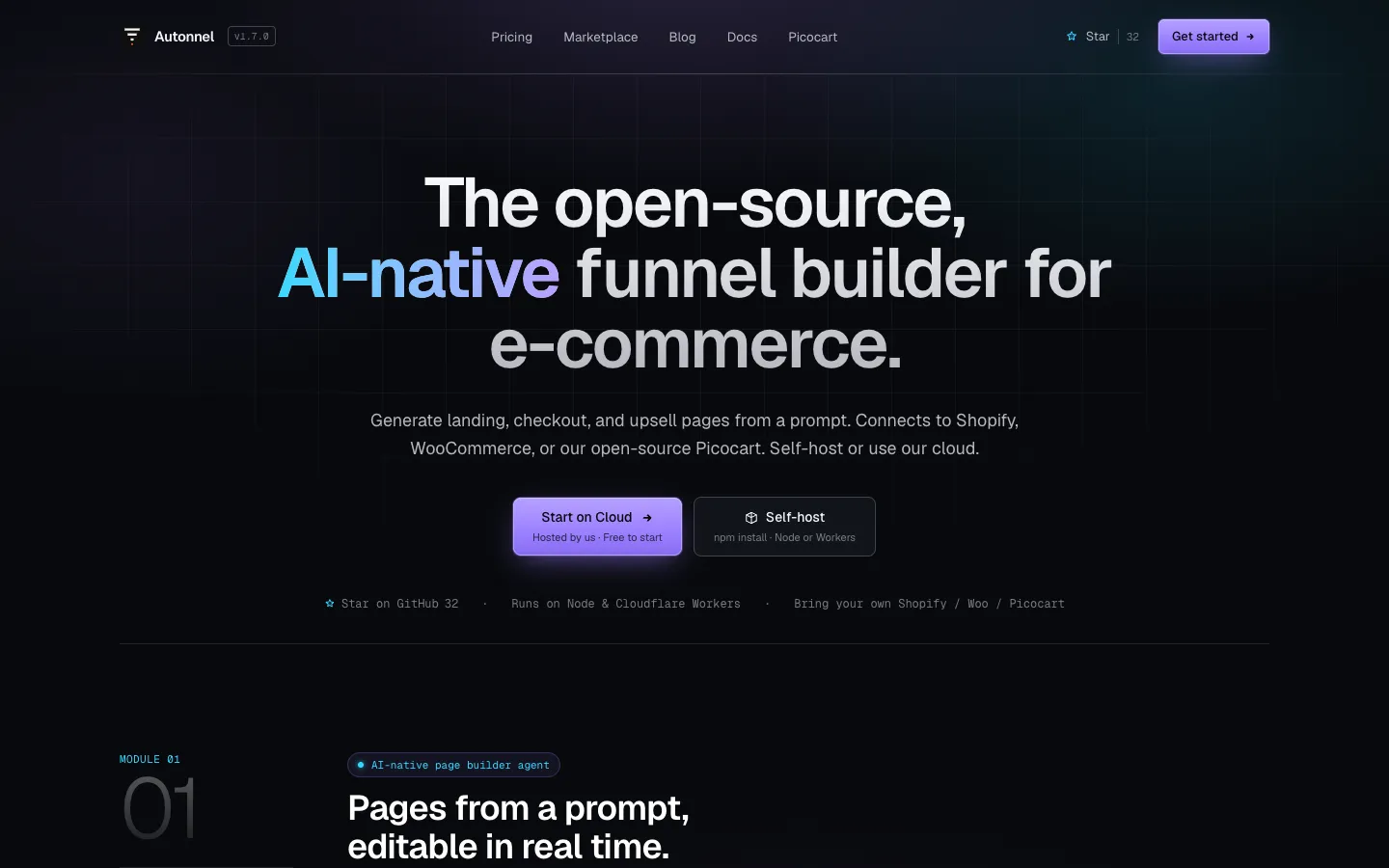
Short description
Autonnel is a funnel and checkout builder for online sellers who run paid ads to their offers. It puts the whole sales path on your own domain: the landing page, order form, order bumps, one-click upsells and thank-you page. Payments go through Stripe or PayPal, and each finished order is created in Shopify, WooCommerce or Picocart, the team's own open-source store backend. It doesn't change your Shopify checkout and doesn't need Shopify Plus.
You build pages in a drag-and-drop editor, paste in raw HTML or copy a live page from its URL. An AI agent in the editor rewrites sections from a plain instruction, using any AI model that accepts OpenAI's request format. A second AI job checks your funnel numbers on a schedule and sends alerts to Slack, email or a webhook, which is an automatic message to another app. Autonnel also has A/B tests across whole funnels, conversion reporting to Meta, TikTok, Google and Bing sent from its server, abandoned-cart emails with coupons, and an MCP server, a standard connection that lets AI agents edit pages and read orders.
The code is released under the Apache-2.0 open-source license and runs on Docker, Node or Cloudflare Workers with no license fee. The managed cloud is a flat $29 a month and takes 0% of revenue. The GitHub repository was created in July 2026, and the current release is v1.7.0. The company's location isn't published.
Features
AI page editing: An Agent panel in the editor changes an existing page from an instruction such as "make the hero darker and move the testimonials below the FAQ", using only components from the built-in catalog. It improves pages started from a template. The docs say it can't create a page from nothing.
Three ways to build a page: A drag-and-drop block editor with templates for landing, sales, checkout, upsell, thank-you, error, policy and advertorial pages; a visual editor for raw HTML; and "Import from URL", which copies a public page and stores its images and files in your own storage.
One-click upsells and order bumps: After the main purchase, extra offers charge the card the buyer already entered, through Stripe or PayPal, so they never type their payment details again.
Whole-funnel A/B tests: Splits visitors between complete funnels by percentage, from 1 to 99% per version, and keeps each visitor on the same version for 30 days. You can't split-test single pages inside a funnel.
Ad conversion reporting: Sends sales to Meta, TikTok, Google Ads and Bing Ads straight from the server, keeping the ad click ID from the landing page through to the order and upsells. Meta, Google Ads and TikTok also get an hourly sync of ad spend, clicks and conversions, matched to each funnel by its landing page address. Bing gets conversions only.
AI conversion analyst: A scheduled job, running anywhere from every 30 minutes to every 24 hours, sends your funnel data to your AI model with your own prompt and delivers what it finds to Slack, email or a webhook.
Funnel analytics: Step-by-step conversion and drop-off, 17 built-in payment and form events, custom events from any button, and an Interest panel that groups visitors by how far they scroll and how long they stay.
Abandoned-cart emails: Three recovery emails by default, sent 24 hours, 72 hours and 1 week after the order, each with an optional coupon. The recovery link keeps the original ad click IDs.
Many domains, one install: Connect any number of custom domains to one setup, each with its own branding, sender address and email provider.
MCP server and API: 20 MCP tools and a REST API let agents such as Claude Code or Cursor list funnels, create and edit pages and media, and read orders. Access uses API keys limited to what you allow, with write access optional.
Roles and permissions: Custom roles with permissions per feature. Sign-in through an outside login provider (OAuth/OIDC) is available as a plugin.
Pricing
You can run Autonnel yourself for free and pay only for your own hosting, or pay a flat monthly fee for the managed cloud. Autonnel takes no share of your sales on any plan. The AI features use your own key from an AI provider, so that provider bills you for the AI use.
Open Source (self-hosted): $0 under the Apache-2.0 license. Runs on Node, Docker or Cloudflare Workers, with all connectors included, your own AI key and support through GitHub Issues. You pay for your own hosting and Postgres database. The site says a typical funnel fits in Cloudflare Workers' free tier of 100,000 requests a day, or $5 a month for 10 million requests.
Cloud (managed): $29 a month, or $23 a month billed yearly (20% off). The price stays flat at any sales volume and includes hosting, updates, analytics, custom domains, every marketplace template and plugin, and email and Slack support.
Cloud free tier: Build and test for free, including the editor, AI generation, test orders and analytics. You can't connect a custom domain, and your pages stay password-protected. Connecting a real domain moves you to the $29 plan. Inactive free accounts are archived, and their data is kept.
Enterprise: A custom flat fee agreed with the team. Includes dedicated resources, company single sign-on (SSO/SAML), an option to run on your own servers and a priority support agreement.
Transaction fees: None from Autonnel: no percentage of sales, no per-order fee and no extra charge on upsells, order bumps or repeat billing. Stripe and PayPal still charge their own processing fees. Until August 2026, Autonnel charged $29 plus 1% of sales.
Marketplace add-ons for self-hosters: One-time purchases you can use on every setup you run. The OAuth2/OIDC Login plugin is $49, the Ad Platform Connectors plugin is $79, and six funnel template packs are $59 each.
AI costs: AI features run on your own AI provider key, so the provider bills you for model use.
Integrations
Platforms: Web admin, either self-hosted or on the managed cloud, which you can run with Docker, Node.js or Cloudflare Workers. There's also a CLI (npx autonnel), a REST API and an MCP server. The research doesn't mention a mobile app.
Shopify: Reads products and writes orders through Shopify's Admin API. You don't need Shopify Plus or a checkout extension.
WooCommerce: Works as another source for products and destination for orders.
Picocart: Autonnel's own open-source store backend, which works with the same API as Shopify.
Stripe: Card payments with the extra bank checks many cards require (SCA/3DS), a test mode, and charges to a saved card for one-click upsells.
PayPal: An Express Checkout button, plus a hold-then-charge payment flow for upsells. Plugins can add other payment providers.
Ad platforms: Meta, TikTok, Google Ads and Bing Ads receive conversions from the server. Meta, Google Ads and TikTok also sync spend and clicks.
Email: Resend, Amazon SES or Cloudflare Email, chosen per domain. The README also lists SMTP, except on Cloudflare Workers.
AI models: Any OpenAI-compatible service, for example OpenAI or Anthropic through a compatible endpoint, plus Cloudflare Workers AI for text and image models.
Storage: Any S3-compatible storage bucket, such as Cloudflare R2, Amazon S3 or MinIO, for media and copied pages.
Slack and webhooks: Receive alerts from the AI conversion analyst.
MCP clients: Claude Code, Claude Desktop, Cursor, Windsurf and other MCP-compatible apps.
Platforms
- Web
- Docker
- Node.js
- Cloudflare Workers
- CLI
- API
- MCP server
Frequently asked questions about Autonnel
Is there an open-source alternative to ClickFunnels?▼
Yes. Autonnel is an Apache-2.0 funnel builder that covers the same core job: landing pages, order forms, order bumps, one-click upsells and split tests. You can run it free on your own server, Docker or Cloudflare Workers, or pay $29 a month for the managed cloud. Autonnel's comparison page lists ClickFunnels' plans at $97 to $297 a month. Autonnel doesn't include courses or email marketing campaigns, and there's no tool to import existing ClickFunnels funnels.
What is the cheapest funnel builder?▼
Autonnel's self-hosted edition has no license fee. You pay only for hosting and a Postgres database, which Autonnel estimates at single-digit to low double-digit dollars a month for a funnel without constant traffic. The managed cloud is $29 a month, or $23 a month billed yearly, and stays the same at any sales volume. You can build and test funnels on the free cloud tier, but pages stay password-protected until you upgrade and connect a domain.
Can you use a funnel builder with Shopify?▼
Yes. Autonnel connects to a standard Shopify store through the Admin API, reads your products and writes each funnel order back to Shopify, so shipping and reporting stay there. The funnel pages run on your own domain outside your Shopify theme, and you don't need Shopify Plus. WooCommerce and Picocart work the same way.
What is the best one-click upsell app for Shopify?▼
Native Shopify apps are the right fit when the upsell has to sit inside Shopify's own checkout. Autonnel runs its own order form and after-purchase pages on your domain instead, and charges the card saved at checkout through Stripe or PayPal, with no second card form. It takes no per-order fee or cut of upsell revenue, then creates the order in Shopify.
What is the best funnel builder for Meta ads?▼
For Meta ads, the main thing to check is how a funnel builder reports sales now that iOS limits tracking. Autonnel sends conversion events to Meta, TikTok, Google Ads and Bing Ads from its server, carrying the click ID from the landing page through checkout and upsells, and retries until the platform accepts them. With Meta connected, it also pulls spend, clicks and conversions for each ad every hour and matches each ad to a funnel by its landing page address.
Similar tools
Alternative AI options