
OneProvider
A prepaid AI API gateway that puts Claude, GPT, Gemini, DeepSeek, Grok, Kimi, GLM, Qwen and other models behind one key and one balance, and on its largest top-ups gives you nearly 15 times the balance you pay for.
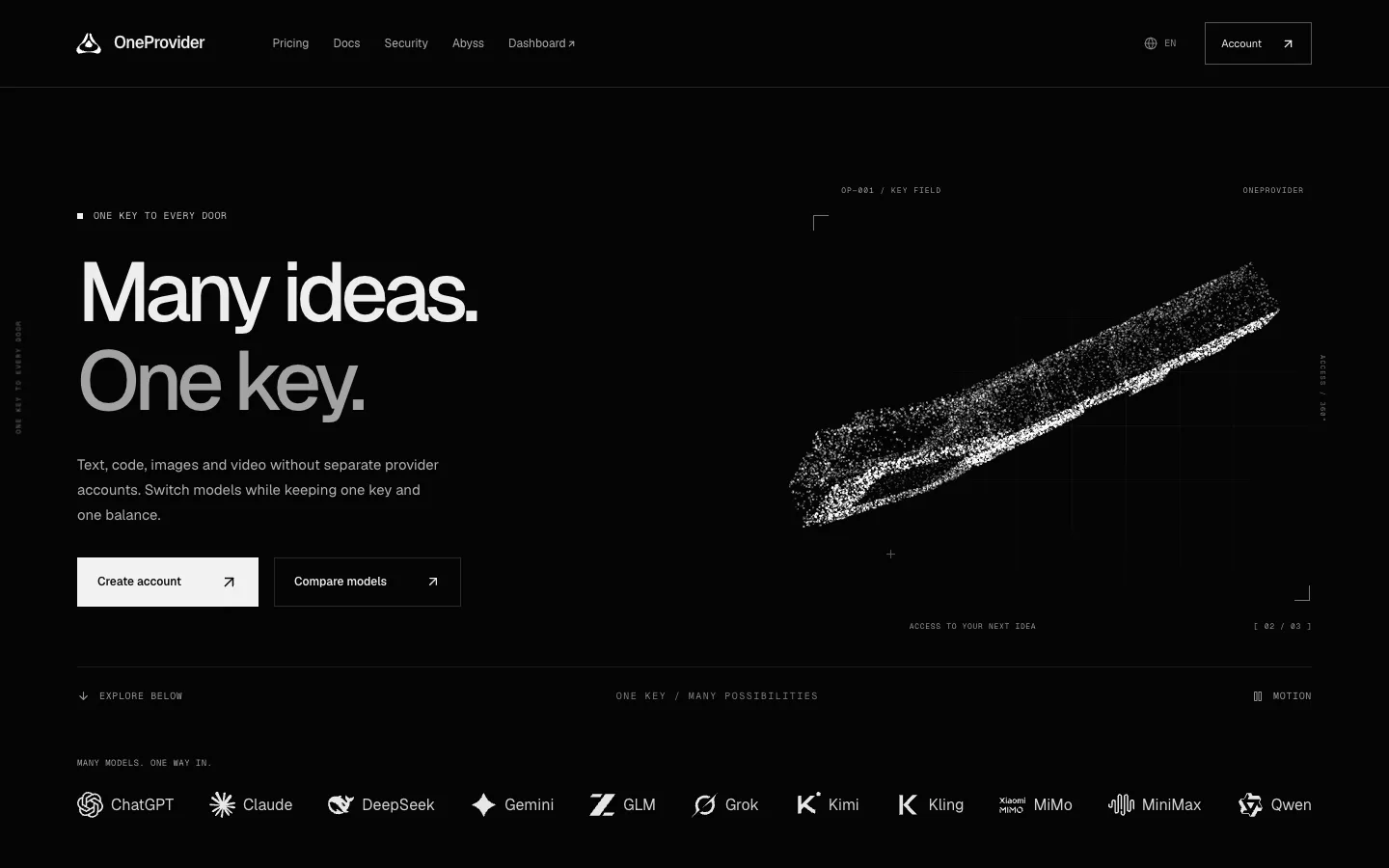
Short description
OneProvider is a pay-as-you-go API gateway for AI models. You top up one balance in US dollars, issue API keys, and call 92 production models through endpoints that copy the Anthropic and OpenAI APIs. Because of that, Claude Code, Codex, Cursor, Cline and n8n work once you swap in OneProvider's base URL and key. Each request is charged at the model's per-token rate in the catalog.
The per-token rates aren't where the savings come from. OneProvider sells balance at a multiple of what you pay: $5 buys $20 of balance, $50 buys $500, and $420 buys $5,000. The vendor puts this at up to 90% savings compared with paying model makers directly. There's no subscription and no auto-charge, and the balance never expires, though each key lasts 90 days before you have to extend it.
You manage everything from a web cabinet or a Telegram bot. The cabinet also has Ask Abyss, a beta research assistant that searches the web, cites its sources and can answer with a chart, table or calculator, paid from the same balance.
OneProvider Ltd runs the service from Nicosia, Cyprus, on servers in Frankfurt, and says it doesn't store prompt text. It launched on Peerlist in week 45 of 2026 and reports more than 967 million requests served.
Features
One key for many model families: A single API key reaches 92 production models from Claude, GPT, Gemini, DeepSeek, Grok, Kimi, GLM, Qwen, MiniMax, MiMo and Kling. The catalog covers text, image and video generation, text-to-speech and speech-to-text.
Anthropic and OpenAI compatible endpoints: https://api.oneprovider.dev accepts requests in Anthropic's Messages format, and https://api.oneprovider.dev/v1 accepts OpenAI's Chat Completions, Responses and Images formats. Existing code keeps working after you change the base URL and key.
Balance multiplier pricing: Each top-up buys more balance than you pay, from 4 times at the $20 tier to 14.88 times at the $5,000 tier.
Cheaper rates for reused context: On supported models, text you send again (such as a long system prompt) is billed at a separate, lower cache rate shown in the catalog.
Keys with spend limits: You get 3 keys by default, and support can raise that. Each key has a name, an optional spending cap and a term of up to 90 days, and you can extend, pause or delete it.
Usage log and balance check from code: Every request appears in the cabinet with its model, tokens and charge, and an API call returns a key's remaining balance.
Free token counting: A count_tokens endpoint tells you how many input tokens a request will use, at no charge.
No prompt logging policy: Under the vendor's policy, prompts, responses and tool-call data aren't written to disk. It logs metadata only, such as time, model, status and token counts.
Ask Abyss research assistant: A beta assistant with a fast Search mode and a Research mode that takes a few minutes and writes a report. Answers carry numbered citations and can come as charts, tables, converters or calculators. It reads PDFs, Word files and spreadsheets, exports documents to PDF, DOCX or Markdown, remembers facts you allow, and can run scheduled tasks that deliver to Telegram.
Telegram cabinet: The @oneprovider_robot bot, and its Mini App, show the same balance, keys, usage and Ask Abyss chats as the web cabinet.
Setup instructions for AI agents: One llms.txt file holds the full documentation, so you can give the link to Claude Code, Codex or Cursor and let the agent configure the client for you.
Reseller API: Resellers get a separate API to manage client keys, orders, batches of top-up codes, plans and webhooks.
Pricing
How billing works: You pay as you go from one prepaid US dollar balance, and each request is charged at the model's rate per million tokens. There's no subscription, monthly fee or auto-charge, and the balance doesn't expire. Once it runs out, requests fail with an "Insufficient balance" error until you top up.
$20 balance: Pay $5, which works out to $4.00 of balance per $1.
$100 balance: Pay $15 ($6.67 per $1).
$250 balance: Pay $30, with a $25 bonus included ($9.17 per $1).
$500 balance: Pay $50 ($11.00 per $1).
$1,000 balance: Pay $90 ($12.78 per $1).
$2,000 balance: Pay $170 ($14.12 per $1).
$5,000 balance: Pay $420 ($14.88 per $1).
Sample model rates: Per million input and output tokens, charged against your balance: Claude Fable 5.1 $10 and $50; Claude Opus 5.5 $4 and $20; Claude Sonnet 5.5 $2 and $10; Claude Haiku 5.5 $0.10 and $0.50; GPT-6.1 Sol $2 and $10; Gemini 4 Argon $2 and $10; DeepSeek V4 Pro $1.32 and $3.96; Kimi K3.1 Pro $2 and $10.
Payment methods and fees: Crypto carries a 3% provider fee plus the network fee. Cards from any country work through Apple Pay or Google Pay. SBP/QR payments in rubles carry a 3.5% fee, and marketplace codes also top up the balance.
Free tier: None is published. Welcome and first top-up bonuses run as promotions, and they can expire and can't be withdrawn or refunded.
Refunds: Billing errors and failed deliveries are refunded in full. Otherwise only unused paid balance can be refunded, case by case at the vendor's discretion, and the refund is based on what you paid, not the balance you received.
Integrations
Claude Code: Point ANTHROPIC_BASE_URL at https://api.oneprovider.dev and put your key in ANTHROPIC_AUTH_TOKEN. The same setup works in the VS Code extension and in the Claude Desktop Code tab, for local sessions only.
Codex (OpenAI CLI): Add OneProvider as a model provider in Codex's config file, and it connects through the Responses API.
Cursor: Uses the OpenAI-compatible base URL, with GPT models only.
Other coding agents: Setup guides cover Cline, OpenCode, Hermes Agent, OpenClaw, Open Cowork and Factory Droid.
n8n: Connects through the HTTP Request node.
Anthropic and OpenAI SDKs: The official Python and Node libraries work after you change the base URL.
Chat apps with custom endpoints: LibreChat, OpenWebUI, TypingMind and other apps that accept a custom OpenAI endpoint.
Telegram: The @oneprovider_robot bot handles the cabinet, top-ups, support and Ask Abyss.
Platforms
- Web
- API
- Telegram
What users complain about OneProvider
Models may not be what's advertised: Several buyers say the answers don't match the Claude model they picked. One ran side-by-side tests against the real Opus 5 and concluded a different model was replying, and others found the quality worse than older or budget models.
Single requests billed more than once: One buyer says a request was sent to the server several times and charged each time, something they hadn't seen with official providers.
Slow responses: Another buyer found API response times slow enough to call the service unusable.
Unclear what you're paying for: The same buyer says the listing didn't make clear that the model behind the proxy might not be Claude.
Frequently asked questions about OneProvider
Is OneProvider legit?▼
OneProvider is run by OneProvider Ltd of Nicosia, Cyprus, and its API gateway sits in Frankfurt behind TLS 1.3 encryption. It publishes terms, privacy, refund and acceptable use policies, a live status page, and a log of every request you make. The balance is prepaid with no auto-charge, so you can't spend more than you top up. Refunds of unused paid balance are decided case by case and bonuses are never refunded, so starting with the smallest top-up ($5 for $20 of balance) keeps your risk low.
Does OneProvider have a free trial or free credit?▼
No standing free tier is published. OneProvider runs welcome and first top-up bonuses as promotions, but they can expire and can't be withdrawn or refunded. The cheapest way in is the $20 balance tier, which costs $5.
How much does OneProvider cost?▼
There's no subscription. You buy balance at a multiple of what you pay, from $5 for $20 up to $420 for $5,000, and each request is then charged at the model's rate per million tokens. Claude Sonnet 5.5, for example, costs $2 for input and $10 for output. The balance never expires, but keys last 90 days and need extending.
How do I use Claude Code with OneProvider?▼
Set ANTHROPIC_BASE_URL to https://api.oneprovider.dev (without /v1), put your OneProvider key in ANTHROPIC_AUTH_TOKEN, pick a Claude model ID from the catalog, and run claude. If a saved claude.ai login gets in the way, run /logout inside Claude Code. Each request then shows up in your cabinet's usage log with its tokens and charge.
Is OneProvider an OpenRouter alternative?▼
It can replace a gateway like OpenRouter in any tool that lets you set a custom base URL. One key covers Claude, GPT, Gemini, DeepSeek and more, through both OpenAI-compatible and Anthropic-style endpoints, and Claude Code is supported natively. The main differences are the prepaid balance packs and the Telegram bot that works alongside the web cabinet.