Claude code
Autonomous AI coding agent from Anthropic that explores codebases, fixes bugs, builds features and orchestrates long-running coding tasks from your terminal, IDE, App or the web.
Short description
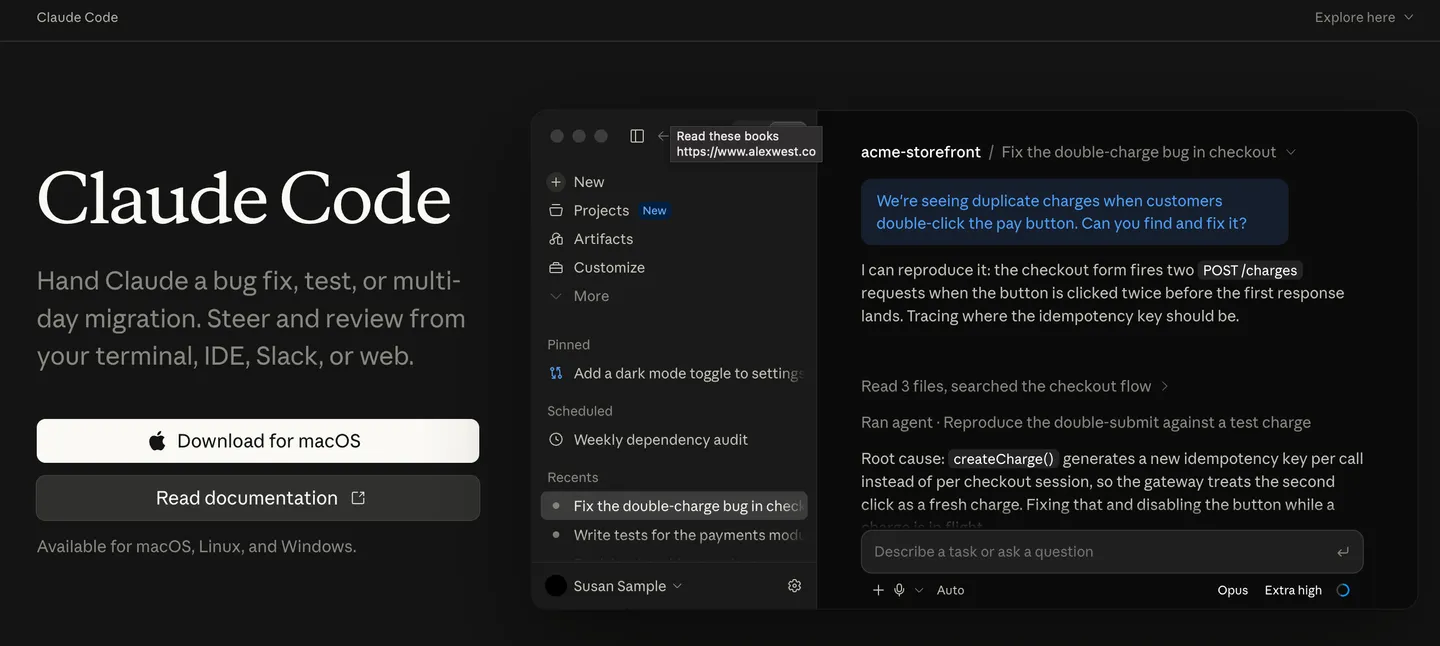
Claude Code is Anthropic’s agentic coding tool, built for developers who want an AI to work across an entire codebase rather than just autocomplete lines of code. It reads and understands existing repositories, edits files, runs commands and tests, and can take software issues from investigation to implementation and pull requests.
Available through the terminal, IDEs, web and desktop, Claude Code combines deep codebase access with sub-agents, reusable skills, MCP integrations and background execution. Its biggest differentiator is the ability to delegate substantial engineering work to Claude’s models while retaining control over how changes are reviewed and executed.
Features
Codebase understanding: Explores unfamiliar repositories, traces dependencies and identifies relevant files before making changes.
Issue-to-PR workflows: Investigates software issues, implements fixes, runs tests and prepares pull requests through supported GitHub integrations.
Multi-step coding: Handles feature development, debugging, refactoring, migrations and test generation across multiple files.
Background agents: Runs coding tasks in the background so you can continue working on other tasks while the agent makes progress.
Parallel agents and worktrees: Delegates independent tasks to sub-agents and uses isolated Git worktrees to work on multiple changes in parallel.
Plan mode: Analyses the codebase and creates an implementation plan before editing files.
Choice of Claude models: Switch between Anthropic’s top models Haiku, Sonnet, Opus and Fable to choose the model that best fits your coding task, balancing speed, intelligence and cost.
Custom instructions and skills: Uses CLAUDE.md, reusable skills, hooks and plugins to follow project conventions and automate workflows.
MCP integrations: Connects external tools, services and data sources through the Model Context Protocol (MCP).
Automated workflows: Supports GitHub Actions and other supported automation setups for repeatable development tasks.
Pricing
Pro: $20/month. Suitable for lighter coding sessions and smaller projects.
Max 5x: $100/month. Provides 5× the Pro usage allowance.
Max 20x: $200/month. Provides 20× the Pro usage allowance.
API alternative: Pay per token through the Anthropic API, with costs determined by the model and usage.
Integrations
MCP servers: Connect external tools and data
GitHub / GitLab & Slack: Work with issues, PRs and team chat
VS Code & JetBrains extensions: Use it inside your IDE
Cursor & Devin Desktop: Native extensions let you run Claude Code inside the editor you already use
Platforms
- Terminal/CLI
- web (claude.ai/code)
- VS Code
- JetBrains
- Slack
- macOS desktop
- iOS/Android and GitHub Actions
What users love about Claude code
Autonomy across real codebases: Can investigate unfamiliar projects, edit multiple files, execute commands and work through complex tasks without requiring constant step-by-step instructions.
Strong coding capabilities: Access to Sonnet and Opus makes it attractive for developers who prioritise code quality, reasoning and difficult debugging.
End-to-end development workflows: Can take a task from investigation through implementation and testing to a proposed pull request.
Flexible working environments: Developers can use the CLI, supported IDEs or desktop interface depending on whether they prefer a terminal-first or graphical workflow.
Customisable agent behaviour: Skills, project instructions, hooks and MCP integrations allow workflows to be adapted to individual projects and teams.
What users complain about Claude code
Token Burn: Long conversations, parallel agents and demanding models can consume subscription allowances rapidly.
API costs can be difficult to predict: Extensive tool use and repeated context processing can make large tasks more expensive than expected.
Terminal-first learning curve: The CLI and configuration options can feel intimidating to developers accustomed to graphical coding environments.
Similar tools
Alternative AI options