
Momentic
An AI testing platform for web, iOS and Android apps where you write tests of whole user flows in plain English, and an AI QA agent called Mo explores your running app from a short prompt and files bug reports it has already reproduced.
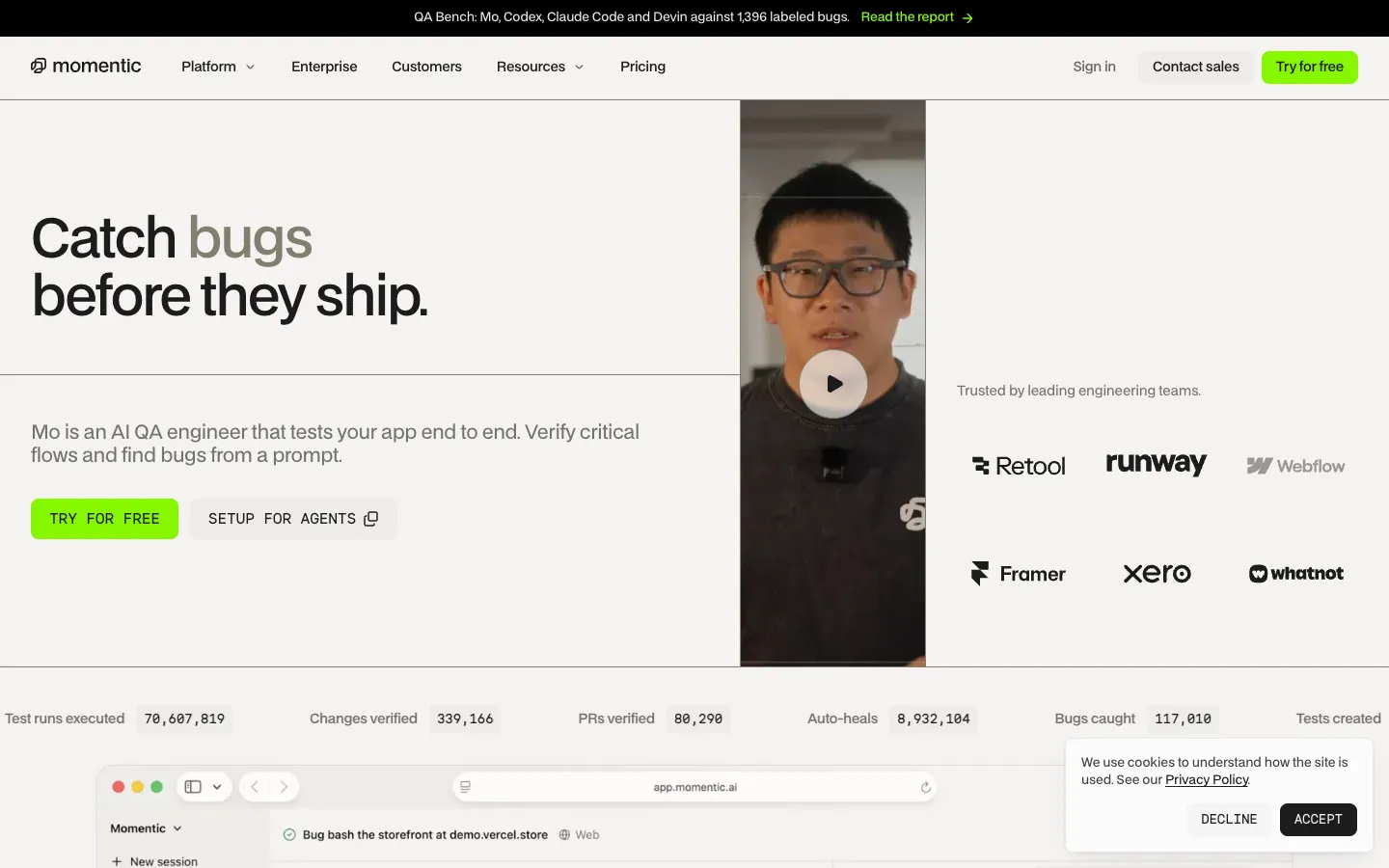
Short description
Momentic is an AI testing platform for web and mobile apps. It focuses on end-to-end testing: instead of checking one function in your code, an end-to-end test uses the finished app the way a person would, for example signing in, adding an item to the cart and checking out, and confirms the whole flow works.
You can use it in two ways. Repository tests are YAML files, a simple text format, that you keep in Git, with steps such as "add the backpack to the cart" and checks written in plain English. Momentic finds buttons and fields from those descriptions instead of fixed code references, so small design changes don't break the test, and it can suggest repairs when they do. Tests run on your computer, in CI (your automated build pipeline) or on browsers, simulators and emulators that Momentic hosts. Mo, launched in November 2026, is an AI QA engineer. You give it a URL or a mobile build and a brief, and it plans test cases, runs several agents at once, has a separate agent reproduce suspected bugs and returns a report with steps and recordings.
Momentic is for engineering teams that run tests in CI and teams using coding agents such as Claude Code, Cursor or Devin. Wei-Wei Wu and Jeff An founded it in 2023. It's part of Y Combinator's W24 batch and based in San Francisco.
Features
Plain-English tests in YAML: Write steps and checks in everyday language, keep them as YAML files in your repository and review changes like any other code.
Find elements by description: Point to things on the page by describing them ("the blue Sign up button") instead of CSS or XPath selectors, the code references that often break when a page changes.
AI actions and AI checks: Give a step a goal and the agent carries it out. Checks can look at text, visuals and the page structure.
Self-repairing tests: Finds controls again when the design changes during a run, suggests lasting fixes to the test file for you to review, and sets aside flaky tests (ones that pass and fail at random) so they don't block your pipeline.
Mo, the AI QA engineer: Explores a web URL or an uploaded iOS or Android build from a prompt, runs helper agents in parallel, has a separate agent reproduce bugs and reports which cases passed, broke or were blocked, with evidence.
Effort levels for Mo: Low (about 15 minutes, for most pull requests), medium (about 30 minutes), high (about 1 hour) and max (about 2 hours, for an entire app).
Web, iOS and Android in one suite: The same test format covers Chromium or Chrome browsers, iOS simulators (native Swift, React Native, Expo and Flutter apps) and Android emulators.
Works with coding agents: Command line tools, MCP servers and skills let Claude Code, Cursor, Codex, Devin, Copilot and other agents write, run and debug tests.
Failure triage: Shows the failing step with screenshots, console and network logs and video, and AI sorts failures into app bugs, flaky tests or environment problems.
AI test selection: Looks at a code change and picks the tests most likely to catch something it broke.
Knowledge base and memory: Add product terms and business rules for agents to use. Marking a Mo finding as intended behavior adds it to the knowledge base.
Test helpers: Throwaway email inboxes, phone numbers for SMS and one-time passcode flows, fake network responses, and access to private networks through a connector or tunnel.
Pricing
Momentic charges in credits, units that each action uses up. A normal test step costs 1 credit, and hosted browsers and devices use credits by the minute.
Free: $0, no credit card. 2,000 credits a month (about 200 runs of 10 steps), 5 hosted browsers at once, 1 hosted mobile session (Android or iOS), 15-minute mobile sessions and 30 days of results history. Usage stops at the limit, and there are no phone numbers for SMS testing.
Pay-as-you-go: $125/month plus usage. 10,000 credits a month (about 1,000 runs of 10 steps), 25 browsers at once, 5 Android emulators plus 5 iOS simulators, 5 phone numbers and a shared Slack channel. Extra credits cost $0.01875 each (1.5x the base rate), or you can top up 10,000 credits for $125. Unused credits don't carry over.
Enterprise: Custom pricing based on tests. Adds SAML SSO and SCIM (company single sign-on and automatic user management), an audit log, 1-hour mobile sessions, higher API limits, an SLA (a service guarantee), onboarding and a dedicated account manager.
Credit rates: 1 credit per test step (2 for AI-generated steps), 1 credit per minute of hosted browser, 8 credits per minute of Android emulator and 15 for iOS simulator, 100 credits per failure classification, 500 per triage run and 300 per AI test selection. Runs in the editor are free.
Mo sessions: Billed on how long the agents actively run, plus hosted browser or device time and AI model usage "at cost". Momentic doesn't publish per-unit Mo prices.
Annual pricing: Not published.
Integrations
Platforms: A web dashboard, command line tools for macOS, Linux and Windows, a local visual editor, MCP servers for coding agents and an API for Mo sessions. It tests web apps in Chromium or Chrome (not Firefox or Safari), iOS apps on simulators and Android apps on emulators. Physical phones aren't supported.
CI providers: GitHub Actions, GitLab CI, CircleCI, Jenkins, Travis CI, Buildkite, Azure DevOps and custom runners, with tests split across jobs to finish faster.
GitHub: A GitHub App posts test summaries on pull requests, opens pull requests with test repairs, and gives Mo access to read repositories and test pull requests.
GitLab: Reads merge request, branch and commit details.
Slack: Notifications for test runs, Mo activity and changes to set-aside flaky tests.
Linear: Mo plans testing from issues and files bugs with steps to reproduce them.
Jira and Confluence: Mo reads issues and specs through Atlassian's Rovo MCP server.
Notion: Mo uses specs and acceptance criteria from connected pages.
Vercel and Cloudflare: Mo tests preview deployments and gets past deployment protection or the firewall.
Coding agents: Claude Code, Cursor, Codex, Devin and Copilot through MCP servers (a standard way to plug tools into AI agents) and skills. Mo sessions can also be started from ChatGPT, Claude or Gemini.
Reports: Results in JUnit, Allure and Playwright JSON formats.
Platforms
- Web dashboard
- CLI (macOS, Linux, Windows)
- local editor
- MCP servers
- API
What users love about Momentic
Plain-English tests that are quick to write and maintain (vendor testimonial): A CTO at an AI-detection startup says the team writes and maintains end-to-end tests about 3x faster, and a head of developer experience at a large productivity app says setup is simple.
Tests on every pull request without slowing CI (vendor testimonial): A founding AI engineer says tests run 6.3x in parallel on every pull request, so the team can trust a passing run.
Bugs found without anyone writing a test (vendor testimonial): An engineering manager at a large file-collaboration platform says pointing Mo at staging before a release turned up 27 bugs in an afternoon.
Checks on AI answers that vary (vendor testimonial): A product operations lead says it gave the team a reliable way to check chatbot responses that change from run to run.
What users complain about Momentic
You pay for Momentic's own AI usage: Developers who already pay for Claude or Codex object that Mo bills its own agent time and AI usage, with no way to use their own model key. One developer who tried it briefly found it slower and more expensive than prompting Claude directly. A team that evaluated the test platform earlier said Playwright with a coding assistant served them better.
Setup can stall on sign-in: A developer who had wanted to try Momentic for a while says Mo had no real onboarding and got stuck asking for login setup, which they didn't have time to work out in the settings.
Rough edges in Mo's report screen at launch: A tester saw "no bugs" messages while the tab counted 11 or 12, every finding marked medium severity, a stop button that only appeared at the end and no obvious way to export the bug list. The team pointed to an export in the command line tool and syncing to Linear.
Unexpected Slack invite on first login: Two new users got a Slack Connect invitation from Momentic right after signing up, with their email shared, even though Slack notifications were off. The team said this was unintended and being fixed.
Hosted devices can lag the newest OS: An iOS developer's build for iOS 27 couldn't install on the hosted simulators at launch (support was added the same day), and testing on physical phones isn't available yet.
Frequently asked questions about Momentic
What is Momentic AI?▼
Momentic is an AI testing platform that writes, runs and repairs end-to-end tests for web, iOS and Android apps. You describe a user flow in plain English, keep it as a YAML file in your repository and run it on your computer, in CI or on browsers, simulators and emulators that Momentic hosts. Its AI QA engineer, Mo, can also explore a running app from a prompt and file reproduced bug reports without any written tests. The company was founded in 2023, is part of Y Combinator W24 and is based in San Francisco.
How much does Momentic cost?▼
The free plan costs $0 and includes 2,000 credits a month, enough for about 200 test runs of 10 steps, with no credit card. Pay-as-you-go costs $125 a month for 10,000 credits, plus extra usage at $0.01875 per credit, and Enterprise pricing is custom. A normal step costs 1 credit, an AI-generated step 2, and hosted browser time 1 credit per minute. Mo sessions bill agent runtime, device time and AI model usage, but Momentic doesn't publish a per-unit Mo price.
Momentic vs Playwright: what's the difference?▼
Playwright is an open-source browser automation library where you write test code and point to elements with selectors. Momentic tests are plain-English YAML steps that find elements with AI, repair themselves when the design changes and can run on hosted browsers and devices for web, iOS and Android. Momentic has a guide for moving Playwright tests over and can output Playwright JSON reports. Playwright is free; Momentic is free up to 2,000 credits a month, then starts at $125 a month.
Can Momentic test mobile apps?▼
Yes. It tests iOS apps on simulators and Android apps on emulators, either on your own machine or on devices Momentic hosts, using the same test format as web. It supports native Swift, React Native, Expo and Flutter apps. Physical devices aren't supported. The free plan includes 1 hosted mobile session at a time, and Pay-as-you-go includes 5 Android emulators and 5 iOS simulators.
What is end-to-end testing, and can AI do it?▼
End-to-end testing checks a whole user flow in the running app, such as signing in, adding an item to a cart and checking out, instead of testing individual pieces of code. With Momentic, an AI agent carries out plain-English steps in a real browser or simulator and checks the result with AI. Mo also decides which flows to test from a short brief, then reproduces each suspected bug before reporting it.
Similar tools
Alternative AI options