Deepgram
Voice AI platform for developers that turns speech into text and powers phone agents, in the cloud or self-hosted.
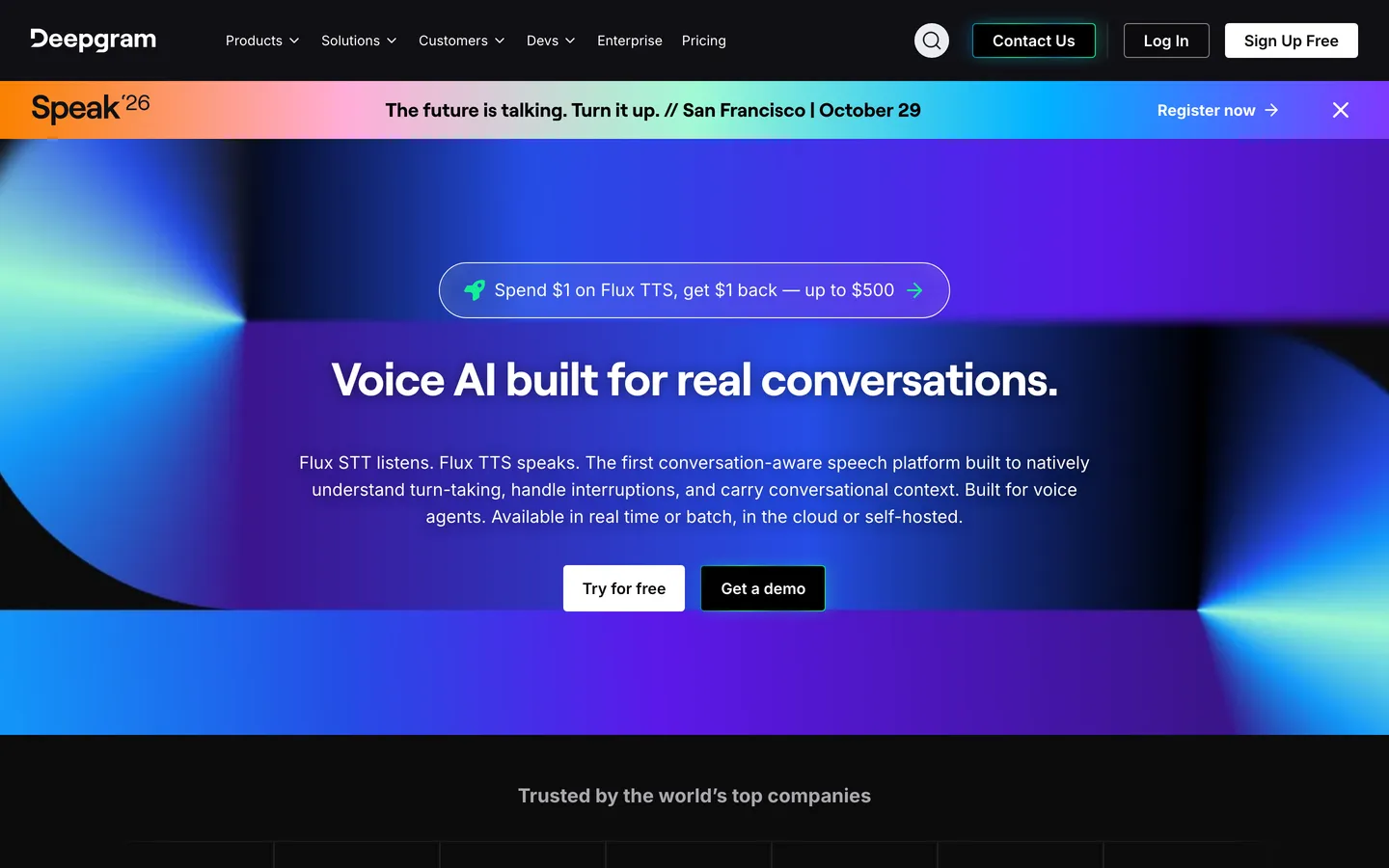
Short description
Deepgram is a voice AI platform for developers best known for transcription that turns live or recorded audio such as calls and meetings into accurate text. It is the main alternative to ElevenLabs' Scribe and Agents, built for real-time speech-to-text at scale, with voices and an all-in-one API for building phone agents. It has no creative tools for voiceovers, dubbing or audiobooks.
Features
Nova-3 speech-to-text: 45+ languages, with speaker labelling, automatic formatting, key-term prompting and automatic language detection
Flux speech-to-text: Recognition built for conversations that detects when a speaker has finished or is interrupting, so agents know when to talk
Aura-2 and Flux text-to-speech: Low-latency voices for agents, with Deepgram citing latency as low as 80ms. Flux TTS keeps the tone consistent across a whole conversation. Flux TTS was free until September 12, 2026 and is now paid.
Voice Agent API: One WebSocket connection handles speech-to-text, LLM, text-to-speech, interruptions and function calling
Audio Intelligence: Summaries, topics, sentiment and intent detection on transcripts
Concurrency: Up to 150-225 live transcription streams and 45-60 TTS streams at once on self-serve plans
Whisper Large: Also hosted
Security and compliance: SOC 2 Type 1 and 2, HIPAA agreements on Enterprise, GDPR, CCPA and PCI
Pricing
How you pay: Usage-based, per audio minute for speech-to-text and agents, and per character for text-to-speech
Pay As You Go: $200 free credit with no card needed. Credit never expires.
Growth: From $4K/yr
Enterprise: Custom
Speech-to-text: Nova-3 from $0.0043/min, about $0.26/hr, vs ElevenLabs Scribe v2 at $0.22/hr
Text-to-speech: Aura-2 at $30 per 1M characters and Aura-1 at $15 per 1M, vs ElevenLabs' $40-80
Voice agents: $0.075/min with the LLM included
Caveat: Current streaming rates are a limited-time promotion. The regular rate is about $0.46/hr.
Integrations
Platforms: Cloud API, including a dedicated EU endpoint (api.eu.deepgram.com) so data stays in Europe, plus self-hosted or private-cloud deployment on Enterprise. There is a web API Playground and console, and no consumer apps.
Developer tools: REST and WebSocket APIs with official SDKs
Voice agent platforms: Vapi, Pipecat (Daily), LiveKit and Twilio, which Deepgram cites as using it in their agent stacks
Customers and partners: Amazon Connect, Cloudflare AI, Sierra and Granola are named as customers or integrations
Bring your own models: Use your own LLM or TTS inside the Voice Agent API
Platforms
- Cloud API
- EU endpoint
- Self-hosted (Enterprise)
- API Playground and console
What users love about Deepgram
Accurate on messy audio: Copes with multiple speakers and background noise on calls and meetings, and keeps error rates low on technical and industry vocabulary
Fast enough for live captions and agents: Low-latency streaming is the reason it gets picked over services built for batch transcription
Quick to integrate: The APIs and SDKs make a working transcription pipeline easy to set up
One vendor for the voice stack: Aura TTS is decent, and the real draw is using it alongside Deepgram's speech-to-text with one less vendor to manage
What users complain about Deepgram
Gaps in less common languages: Support is weaker outside major languages like English, Spanish and Portuguese
Accuracy drops with heavy accents and crosstalk: Very heavy accents, overlapping speakers and niche jargon hurt accuracy unless you tune it with key-term prompting
Costly to test at scale: Pricing is steep for long evaluation cycles, and today's low streaming rates are a promotion
Aura voices are plain and few: Serviceable for agents but less expressive than ElevenLabs, with far fewer voices, no cloning, and not the fastest TTS
Thin docs for advanced setups: Documentation gets sparse beyond standard configurations
Similar tools
Alternative AI options