
Alternatives to ElevenLabs
Explore the best alternatives to ElevenLabs. Compare features, pricing, integrations and see which tool fits your needs.
Why people switch away from ElevenLabs:
Credits run out fast at volume: Long-form work, regenerations and dubbing drain credits quickly. One Creator plan ran out in 4 days, a 9-minute dub used 121k credits, and a creator on a $330/mo plan still had to watch usage closely.
High API price per character: $40-80 per 1M characters on the current price list, and community comparisons still quote about $100 per 1M for v3. A user-compiled comparison puts Google, OpenAI, Fish Audio and Inworld at about $8-30 per 1M.
Hard-to-predict bills: Every product uses the shared credit pool at a different rate
Moderation and verification blocks: Content warnings and bans, for example for fan fiction in ElevenReader, and voice-cloning verification steps that block some projects
Agents need extra vendors: Production phone agents still need your own phone provider, and LLM costs sit on top of the per-minute fee
Cloud-only: Your audio and scripts go to ElevenLabs' servers, while open-weights models can now run locally for free
TL;DR:
The best overall alternative to ElevenLabs is Fish Audio. It covers the same core job of lifelike text-to-speech and voice cloning from a short sample with inline emotion tags, at $15 per 1M characters vs ElevenLabs' $40-80. For real-time voice agents, Cartesia starts speaking in under 90ms and charges $0.06/min for agents, with phone service bundled.
If you are looking for video dubbing, Rask AI lets you edit the translated script, lock in key terms and lip-sync the result, from about $0.67/min. And the best free, fully local option is VoiceStudio, an open-source desktop app for cloning, dubbing and transcription with no credits or cloud uploads.
Fish Audio
Low-cost text-to-speech and voice cloning API built on its own open-weights Fish Speech models that you can also run on your own GPU.
Features
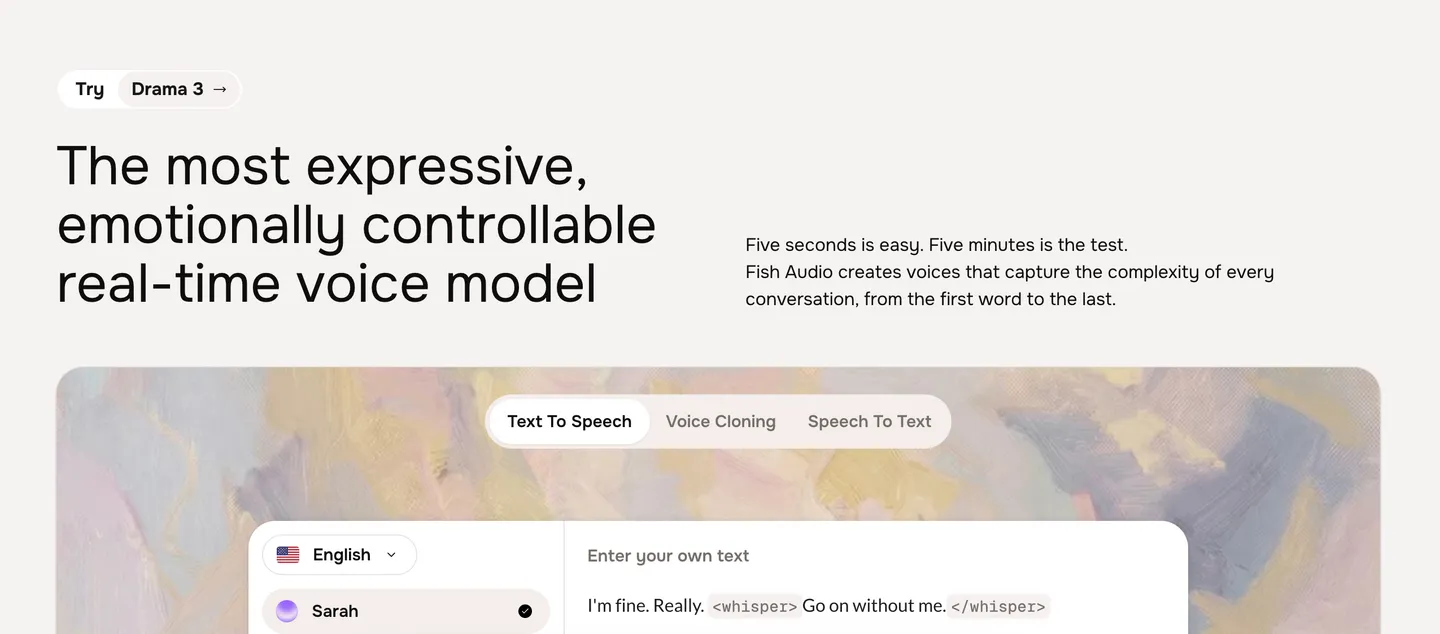
Zero-shot voice cloning: Clones a voice from 10-30 seconds of reference audio with S2 Pro, with no training step
Inline emotion and pacing tags: Tags such as [pause], [excited], [whisper] and [laughing] change delivery mid-sentence
80+ languages: S2 Pro lists 80+ languages, with Japanese, English and Chinese as its strongest
Real-time streaming: WebSocket streaming for voice agents, with about 100ms to first audio on an H200 GPU, per the vendor's figure for S2 Pro
Voice Design API: Generates candidate voices from a text description
Community voice library: Unlimited public voices on paid plans
Models: s2.1-pro on the API, S2 Pro open weights released in 2026, and the newer Drama 3 open release on GitHub, a 35B mixture-of-experts model
Security and compliance: SOC 2 on Enterprise only
Pricing
How you pay: Monthly credit plans for the web app, or pay-as-you-go for the API
Free: $0, about 7 minutes of audio a month, non-commercial
Plus: $11/mo
Pro: $75/mo, up to 1,620 minutes of audio
Max: $749/mo
Enterprise: Custom
API: $15 per 1M bytes, about 1M English characters, vs ElevenLabs' $40-80 per 1M characters
Self-host: Free open weights. The S2 Pro model needs a paid licence for commercial use.
Why it's better than ElevenLabs
Much lower API price: $15 per 1M bytes vs ElevenLabs' $40-80 per 1M characters. Users rate it comparable to ElevenLabs at a fraction of the price, and one community comparison put ElevenLabs v3 at about $100 per 1M vs Fish at $15.
Better cloning for some users: One user rated S2 Pro cloning far better than ElevenLabs v3
Runs locally or privately: Open weights let you self-host, and businesses under $500K revenue get free commercial use of the Community-licensed weights. ElevenLabs is cloud-only.
More audio per dollar on subscriptions: Fish Pro gives up to 1,620 minutes for $75/mo vs about 600 minutes of TTS on ElevenLabs Pro at $99/mo
What you might lose if you switch
No Studio, Dubbing, Music, Agents or ElevenReader: You give up ElevenLabs' 10,000+ curated voice library, Studio long-form editor, Dubbing v2, Music and sound effects, Agents platform and ElevenReader
Weaker outside its top languages: One user rated the Spanish output very poor, so languages beyond Japanese, English and Chinese trail ElevenLabs' 70-90+ languages
Thin compliance: SOC 2 is on Enterprise only, with no HIPAA agreement, FedRAMP or ISO certifications comparable to ElevenLabs
Complicated licences: Self-hosting S2 Pro is non-commercial unless you buy a licence, and the Community License bars reselling hosted TTS
Self-hosting takes a strong GPU and upkeep: S2 Pro is among the slower local models at about 3x real-time on an RTX 5090
Cartesia
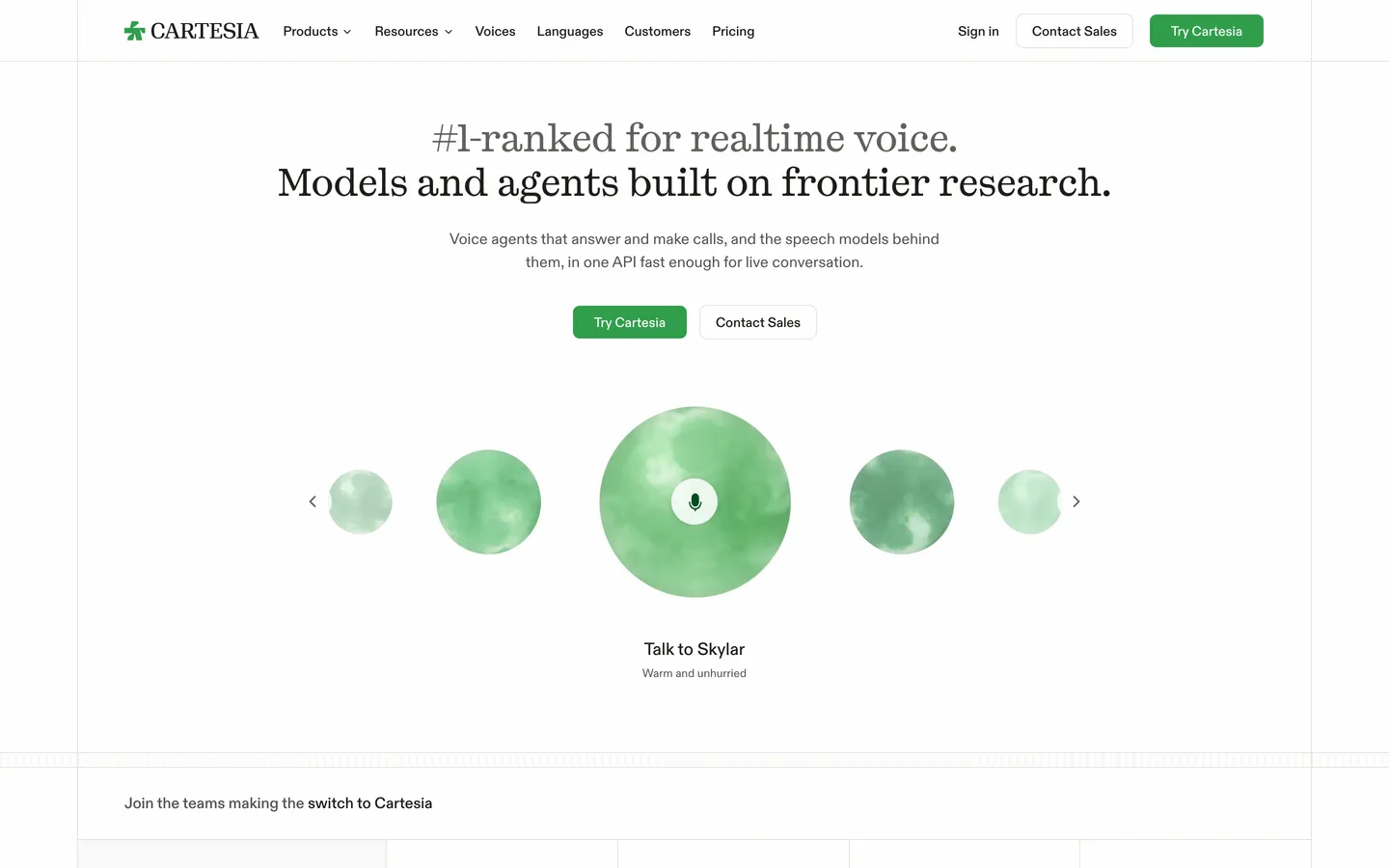
Ultra-low-latency text-to-speech (Sonic), speech-to-text (Ink) and managed voice agents built for real-time AI conversations.
Features
Sonic-3.6 text-to-speech: One model covering 44 languages, with the vendor claiming first audio in under 90ms
Emotion and pacing from the text: Works out emotion and pacing from the script itself without special markup (SSML), and handles fillers like uhm naturally
Inline non-verbal sounds: Insert laughter and similar sounds directly into the text
Instant and Pro voice cloning: Clones from about 10 seconds of audio, with higher-quality Pro cloning slots on paid plans
Localization: Re-voices clips into other languages while keeping the speaker's identity and emotion
Pronunciation dictionaries: Fix how brand names and industry terms are spoken
Ink speech-to-text: Cartesia's own speech recognition model, which turns spoken audio into written text. In a voice agent, Ink handles listening to the caller, while the Sonic voices handle speaking back.
Managed Agents: Hosted voice agents on the same platform, with built-in phone numbers, so you can run a phone agent without a separate phone provider. Costs $0.06/min, with phone service at $0.014/min
Security and compliance: HIPAA business associate agreements (BAAs) on Enterprise only
Models: Sonic-3.6 (Aug 2026), with older sonic-3 and sonic-turbo still available, plus Ink
Pricing
How you pay: Monthly credit plans, where 1 credit = 1 character of speech
Free: $0, 20K characters a month, no commercial use or cloning
Pro: $5/mo
Startup: $49/mo
Scale: $299/mo
Enterprise: Custom
API: About $37-50 per 1M characters vs ElevenLabs' $40-80, so close to the same price rather than a big saving
Voice agents: $0.06/min vs ElevenLabs' $0.08/min, with phone service bundled at $0.014/min
Why it's better than ElevenLabs
Faster first audio: Under 90ms to first audio, tuned for conversations where callers interrupt. Users report ElevenLabs latency getting worse when many calls run at once.
Cheaper agents with phone service included: $0.06/min vs ElevenLabs' $0.08/min base, with phone service bundled at $0.014/min instead of bringing your own Twilio account
Cheapest way into commercial cloning: Instant cloning plus commercial rights for $5/mo, vs ElevenLabs Starter at $6
Very cheap automated video: One creator makes a full automated 10-minute YouTube video for under about $2 using Cartesia for voice, with images, video and LLM included, vs $330/mo on ElevenLabs
What you might lose if you switch
No long-form narration: There is no Studio or Projects editor, and users report Cartesia turns robotic after 3-4 minutes of continuous speech, where ElevenLabs v3/v4 keep the emotional arc
No dubbing, music or creative tools: No Dubbing v2, Music, sound effects, Voice Changer or Isolator, ElevenReader or 10,000+ voice library
Fewer languages: 44 vs ElevenLabs' 70-90+
Thin compliance: HIPAA agreements only on Enterprise, and no public FedRAMP or ISO certifications comparable to ElevenLabs
Little API saving: The per-character price is close to ElevenLabs Flash, so how much you save depends on which ElevenLabs model you compare against

MiniMax Audio
Text-to-speech tool (Speech 2.8) that clones a voice from a 10-second sample, creates new voices from a text description, and adds emotions like breaths, laughs and fillers like "um" into the speech.
Features
Speech 2.8 HD and Turbo: HD for the highest quality, Turbo for cheaper and faster output. Launched January 23, 2026, alongside older 2.6 and 02 models.
10-second voice cloning: Captures a voice's texture, breathiness and speaking pace from a short sample
Voice Design: Creates a new voice from a text description
Sound tags and fillers: Inline breath, laugh, chuckle and clear-throat sounds, plus natural um and uh fillers
Long-text jobs: An async API that handles up to 1M characters per request, for audiobook-scale work
40+ languages: Per third-party hosts Together, Replicate and Cloudflare, though Replicate's HD page says 32. MiniMax's own page doesn't confirm a number.
Music 3.0 and Voice Isolator: Music generation and background-noise removal in the same Audio app
Pricing
How you pay: Pay-per-character API, or monthly plans for the web app that give you audio points
Starter: $5/mo
Standard: $30/mo, up to 100 custom voices
Pro: $99/mo, 1.1M points and up to 250 custom voices
Scale: $249/mo
Business: $999/mo
API: $60 per 1M characters for Turbo and $100 per 1M for HD, vs ElevenLabs' $40-80, so not cheaper
Cloning: $1.50 per cloned voice on the API
Voice Design: $3 per voice
Why it's better than ElevenLabs
More audio on the $99 plan, if points equal characters: MiniMax Pro gives 1.1M points for $99 vs 600k credits on ElevenLabs Pro.
More custom voice slots: Up to 250 custom voices on Pro and 100 on Standard, vs 30 on ElevenLabs Creator and 160 on Pro
Cloning priced per voice, not per plan:
Much longer requests: Async jobs up to 1M characters per request vs 5k characters per request on ElevenLabs v3
Native MCP server: Lets AI assistants and coding tools generate audio without custom code
What you might lose if you switch
Higher API price: Turbo at $60 and HD at $100 per 1M characters cost more than Eleven Labs Flash/Turbo ($40) and v4 ($80)
No Studio, Dubbing, sound effects, Agents, transcription or ElevenReader: None of ElevenLabs' Studio long-form editor, Dubbing v2, sound effects, Agents platform, Scribe-class speech-to-text or ElevenReader
No published compliance and data held by a Chinese vendor: No published SOC 2, HIPAA or FedRAMP equivalent, from a company headquartered in China
Unclear plan quota: Audio points have no published conversion to characters
Unconfirmed language count: MiniMax's own pages don't state how many languages it supports
Murf AI
Voiceover studio for creators and training teams & a text-to-speech API (Falcon) for real-time voice agents that costs one cent per 1,000 characters.
Features
Falcon text-to-speech: Murf claims under 55ms model latency and about 130ms to first audio, holding steady at up to 10,000 calls at once. Falcon and Falcon 2 are the agent models.
Code-mixing: One Falcon voice switches languages mid-sentence, useful for callers who mix Hindi and English or Spanish and English
MultiNative voices: One voice keeps the same identity across 35+ languages, so a narrator stays consistent when content is translated
Studio timeline editor: Sync voiceover to video or slides, then fine-tune pitch, speed, pauses and emphasis on individual words. Runs on the Gen2 studio model.
Say It My Way: Record a line yourself and the AI voice copies your delivery and intonation
Pronunciation library: Saves custom pronunciations for brand names and jargon and reuses them across projects
Dubbing: Automatic video translation into 40+ languages, with human quality review on Enterprise
Murf Agents: A separate enterprise platform for conversational agents
Voices: 150+ Falcon voices and 200+ Studio voices
Security and compliance: SOC 2 Type II, ISO 27001, GDPR and HIPAA at the API Enterprise tier
Pricing
How you pay: Annual seat plans for the Studio editor, or pay-as-you-go per character for the API
Free: $0 Studio plan with 10 minutes of voice and no downloads, plus $10 of API credit
Creator: $19/mo (billed annually)
Business: $66/mo (billed annually), where the expressive features sit
Enterprise: Custom
Falcon API: $10 per 1M characters vs ElevenLabs' $40-80. API credit doesn't expire.
Dubbing: About $0.50/min for Murf Dub
Caveat: Murf's pricing page shows only annual Studio prices, with no month-to-month option
Why it's better than ElevenLabs
A quarter of the API price: Falcon costs $0.01 for 1K characters, a quarter of ElevenLabs Flash/Turbo ($0.04) and an eighth of v3/v4 ($0.08)
Steadier latency under load: One developer running a live speech-to-LLM-to-speech phone agent found Falcon's ~130ms stayed in a tight range with many calls, while ElevenLabs' latency swung widely
API credit doesn't expire: ElevenLabs' monthly credits only roll over for 2 months
Built-in slide and design workflows: Canva, PowerPoint and Google Slides plugins for marketers and trainers, which ElevenLabs doesn't have
On-premise option: SOC 2 Type II, ISO 27001, GDPR, HIPAA and on-premise deployment at API Enterprise, where ElevenLabs is cloud-only
What you might lose if you switch
Far fewer voices: 150+ Falcon or 200+ Studio voices vs ElevenLabs' 10,000+ library
No self-serve Professional Voice Cloning: Murf sells custom clones only as an Enterprise add-on
Less expressive long-form narration: No equivalent to Eleven v3/v4 expressiveness and audio tags for emotional narration
No music, sound effects, transcription or ElevenReader: Also no Scribe-grade speech-to-text
Fewer languages: 35+ vs ElevenLabs' 70-90+
Fewer certifications: No FedRAMP or the broader ISO set that ElevenLabs has

Inworld TTS
Low-latency & low-cost real-time text-to-speech API for voice agents and consumer apps, with speech-to-text and an LLM router on the same API.
Features
Realtime TTS-2 (inworld-tts-2): Flagship model with a vendor-stated ~100ms time to first audio for 90% of requests, plus control over delivery, pauses and pronunciation, and timestamps with phonemes and visemes (mouth shapes) for lip-syncing avatars
TTS-2 Flash (inworld-tts-2-flash): Cheapest and fastest model, with a vendor-stated ~20ms server-side response time, and as low as 50ms on the Coval benchmark per the vendor. It drops professional cloning and delivery control.
Instant voice cloning: Makes a voice from about 3-30 seconds of audio, on both models
Professional voice cloning (beta): Higher-quality clones on TTS-2 only, capped per plan
Voice design (preview): Creates a new voice from a text description
Speech Reasoning (beta): Writes delivery directions for each line automatically
Languages: The marketing page claims 500+ with dialects, while the docs list 200+. Flash covers fewer.
Retired models: TTS-1 and TTS-1-Max were shut down on 2026-06-15, with requests rerouted to newer models automatically. TTS-1.5 Max and Mini are deprecated.
Speech-to-text and LLM router: Available on the same API, so one vendor covers listening, thinking and speaking
Pricing
How you pay: Pay-per-character API, with optional monthly plans that pre-buy credit at a discount
Free: No free plan. On-Demand has no monthly fee and bills only per character.
Creator: $25/mo
Builder: $100/mo
Developer: $300/mo, with 10,000 custom voices
Growth: $1,500/mo
Enterprise: Custom
TTS-2 Flash: $7-15 per 1M characters depending on plan
TTS-2: $12.50-25 per 1M characters, vs ElevenLabs' $40-80
Rollover: Subscription credits roll over for 3 months
HIPAA: A Growth-plan add-on
Caveat: The lowest rates, as low as $5 per 1M, need an Enterprise sales deal
Why it's better than ElevenLabs
Much lower price: Flash costs $7-15 per 1M characters and TTS-2 $12.50-25, vs $40-80 at ElevenLabs. Artificial Analysis lists $10.4 and $20.8 per 1M vs $40 and $80 for Eleven v4 Turbo and v4.
Faster first audio: The vendor says Flash returns first audio up to 3x sooner than ElevenLabs, at 183ms on Coval's leaderboard
Built-in lip-sync data: Viseme and phoneme timestamps suit avatars and game characters
Longer rollover and more voice slots: Credits roll over for 3 months vs 2 on ElevenLabs, and the $300 tier includes 10,000 custom voices
What you might lose if you switch
Lower-ranked voice quality: On the Artificial Analysis leaderboard (viewed 2026-10-15), Realtime TTS-2 ranks #7 (Elo 1259) and Flash #12 (Elo 1218), behind Eleven v4 Turbo at #1 (1328) and v4 at #2 (1326). Inworld's launched-at-#1 claim is no longer current.
No Studio, Dubbing, Music or ElevenReader: Also no sound effects or 10,000+ community voice library
No ready-made agent platform: Nothing comparable to ElevenLabs Agents, so you build agents yourself with LiveKit or Pipecat
Thin compliance: No SOC 2 claim on the TTS page, and HIPAA is a Growth add-on, vs ElevenLabs' broader certifications
Professional cloning still in beta

Deepgram
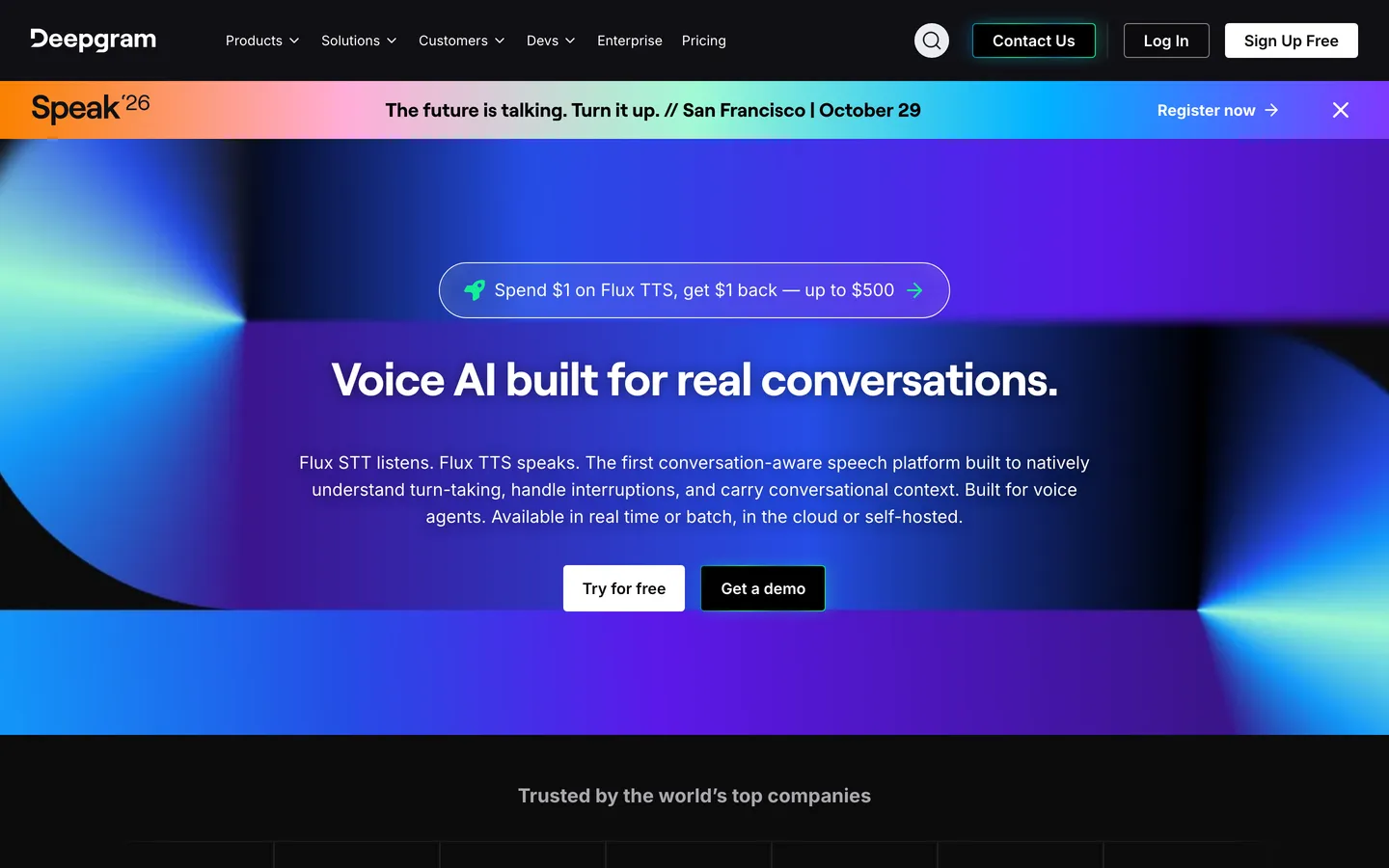
Voice AI platform for developers that turns speech into text and powers phone agents, in the cloud or self-hosted.
Features
Nova-3 speech-to-text: 45+ languages, with speaker labelling, automatic formatting, key-term prompting and automatic language detection
Flux speech-to-text: Recognition built for conversations that detects when a speaker has finished or is interrupting, so agents know when to talk
Aura-2 and Flux text-to-speech: Low-latency voices for agents, with Deepgram citing latency as low as 80ms. Flux TTS keeps the tone consistent across a whole conversation. Flux TTS was free until September 12, 2026 and is now paid.
Voice Agent API: One WebSocket connection handles speech-to-text, LLM, text-to-speech, interruptions and function calling
Audio Intelligence: Summaries, topics, sentiment and intent detection on transcripts
Concurrency: Up to 150-225 live transcription streams and 45-60 TTS streams at once on self-serve plans
Whisper Large: Also hosted
Security and compliance: SOC 2 Type 1 and 2, HIPAA agreements on Enterprise, GDPR, CCPA and PCI
Pricing
How you pay: Usage-based, per audio minute for speech-to-text and agents, and per character for text-to-speech
Pay As You Go: $200 free credit with no card needed. Credit never expires.
Growth: From $4K/yr
Enterprise: Custom
Speech-to-text: Nova-3 from $0.0043/min, about $0.26/hr, vs ElevenLabs Scribe v2 at $0.22/hr
Text-to-speech: Aura-2 at $30 per 1M characters and Aura-1 at $15 per 1M, vs ElevenLabs' $40-80
Voice agents: $0.075/min with the LLM included
Caveat: Current streaming rates are a limited-time promotion. The regular rate is about $0.46/hr.
Why it's better than ElevenLabs
Cheaper agents with the LLM included: $0.075/min all-in vs ElevenLabs' $0.08/min with LLM and phone costs billed on top
Cheaper text-to-speech: Aura-2 at $30 per 1M and Aura-1 at $15 per 1M characters, vs $40-80
Self-hosting and EU data storage: Suits regulated or on-premise work, where ElevenLabs is cloud-only
Built for live turn-taking: Flux speech-to-text detects end-of-turn natively for live agents
Credit that never expires: Pay As You Go credit doesn't expire, while ElevenLabs credits roll over for only 2 months
One less vendor: If you already use Deepgram for transcription, Aura TTS means one less service to manage
What you might lose if you switch
Cheaper batch transcription: Scribe v2 at $0.22/hr is cheaper than Nova-3 pay-as-you-go
No voice cloning or expressive narration: No Instant or Professional cloning, no 10,000+ voice library, and no v3/v4 expressive narration. Deepgram's voices are built for agents.
No Studio, Dubbing, Music or ElevenReader: Also no sound effects
Fewer TTS languages and certifications: No 70-90+ language TTS range, and no FedRAMP or ISO 42001

Vapi
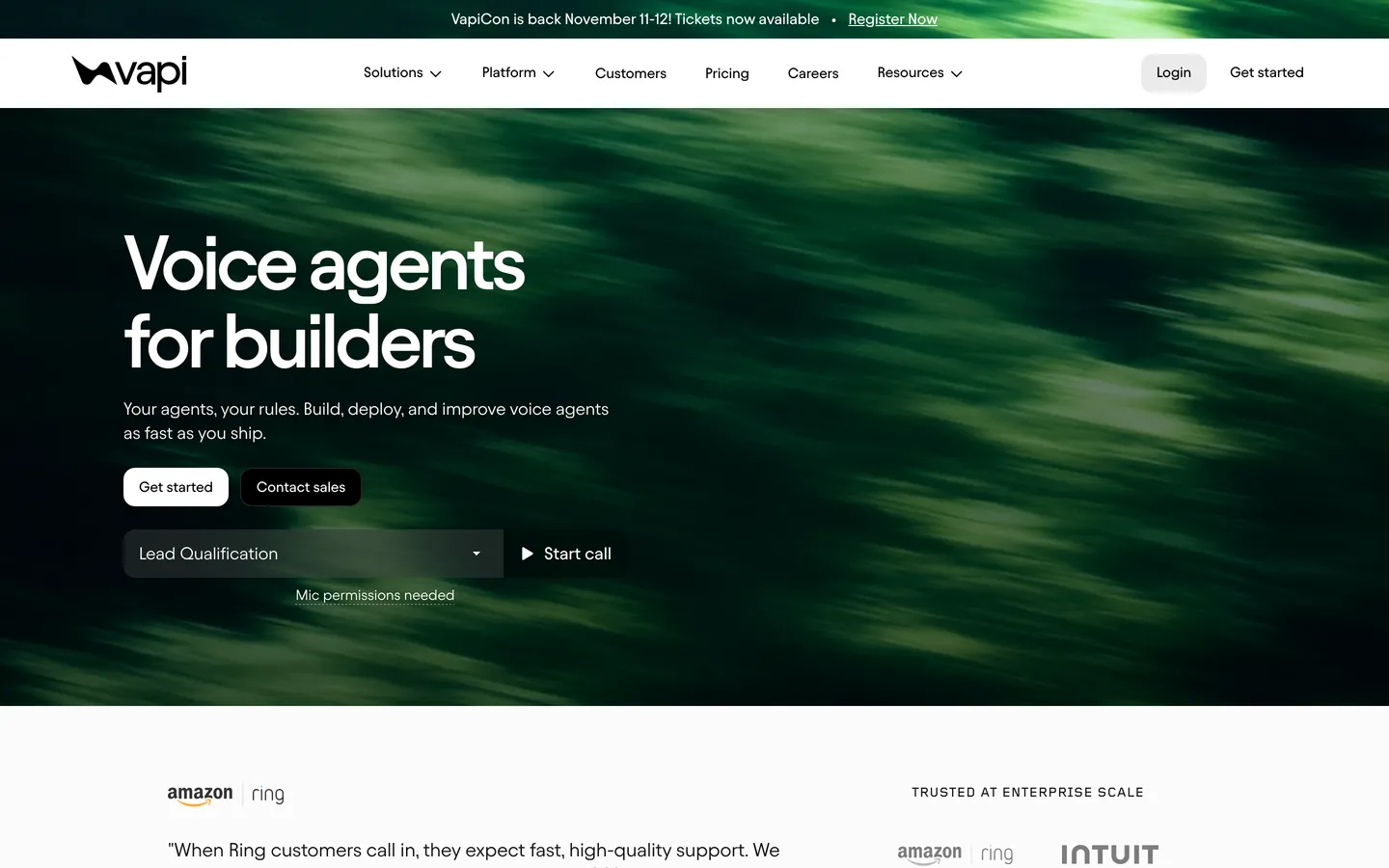
Developer platform for building phone and web voice agents where you get to choose the speech-to-text, LLM and voice provider for each agent.
Features
Choose your own providers: Pick separately among LLMs (OpenAI, Anthropic, Gemini, Groq, Perplexity), voices (ElevenLabs, Cartesia, Azure and others) and transcribers (Deepgram, AssemblyAI, Gladia)
Sub-500ms latency claim: The vendor's stated average time between a caller finishing and the agent replying, also claimed at enterprise scale
Build, test and deploy: Design call flows, test them and ship them, with live call monitoring and call tracking
Free built-in phone and web calling: Vapi Telephony/SIP, WebSockets and Daily WebRTC carry no transport charge, or bring your own carrier
Pay per call line: Buy extra simultaneous call lines for $10 each instead of moving to a higher plan
Enterprise controls: SSO, OAuth2, role-based access, AI guardrails and zero data retention on paid packages
Scale claims: 1M+ developers, 2.5M+ agents and 1B calls
Pricing
How you pay: A per-minute platform fee, with speech-to-text, LLM, voice and phone charges billed at each provider's cost
Free to start: $0, then pay-as-you-go from prepaid credit
No package: $0
Core: $29/mo
Pro: From $999/mo
Premier: Custom
Per minute: $0.05 platform fee vs ElevenAgents' $0.08, about $0.08-0.13 all-in
Extra call lines: $10 per extra simultaneous call line
ElevenLabs voices inside Vapi: $0.0146-0.0238/min at cost
HIPAA: $2,000/mo add-on
Why it's better than ElevenLabs
Lower platform fee: $0.05/min vs ElevenAgents' $0.08/min overage, with speech-to-text, LLM and TTS passed through at cost
No voice lock-in: Keep ElevenLabs voices inside Vapi at $0.0146-0.0238/min, or swap to Cartesia or Azure per agent for cost or speed
Choice of transcriber: Pick Deepgram, AssemblyAI or Gladia, where ElevenAgents uses ElevenLabs' own stack
Buy call capacity as you need it: $10 per extra line instead of plan tiers
What you might lose if you switch
No single bill: ElevenAgents puts agent minutes in the same credit plan as TTS, Dubbing and Music, while Vapi means several provider accounts and bills
No ElevenLabs agent extras: No Expressive Mode, no Scribe v2 Realtime tightly paired with v4 voices, and no 30 built-in LLMs without managing your own API keys
Pricier compliance: HIPAA costs $2,000/mo on Vapi, while ElevenLabs offers HIPAA agreements on Enterprise plus SOC 2, ISO 27001 and FedRAMP 20x
No creative suite: No Studio, Dubbing, Music, sound effects or 10,000+ voice library
Needs engineering work: Despite the dashboard, reviewers say most production deployments need developers

Rask AI
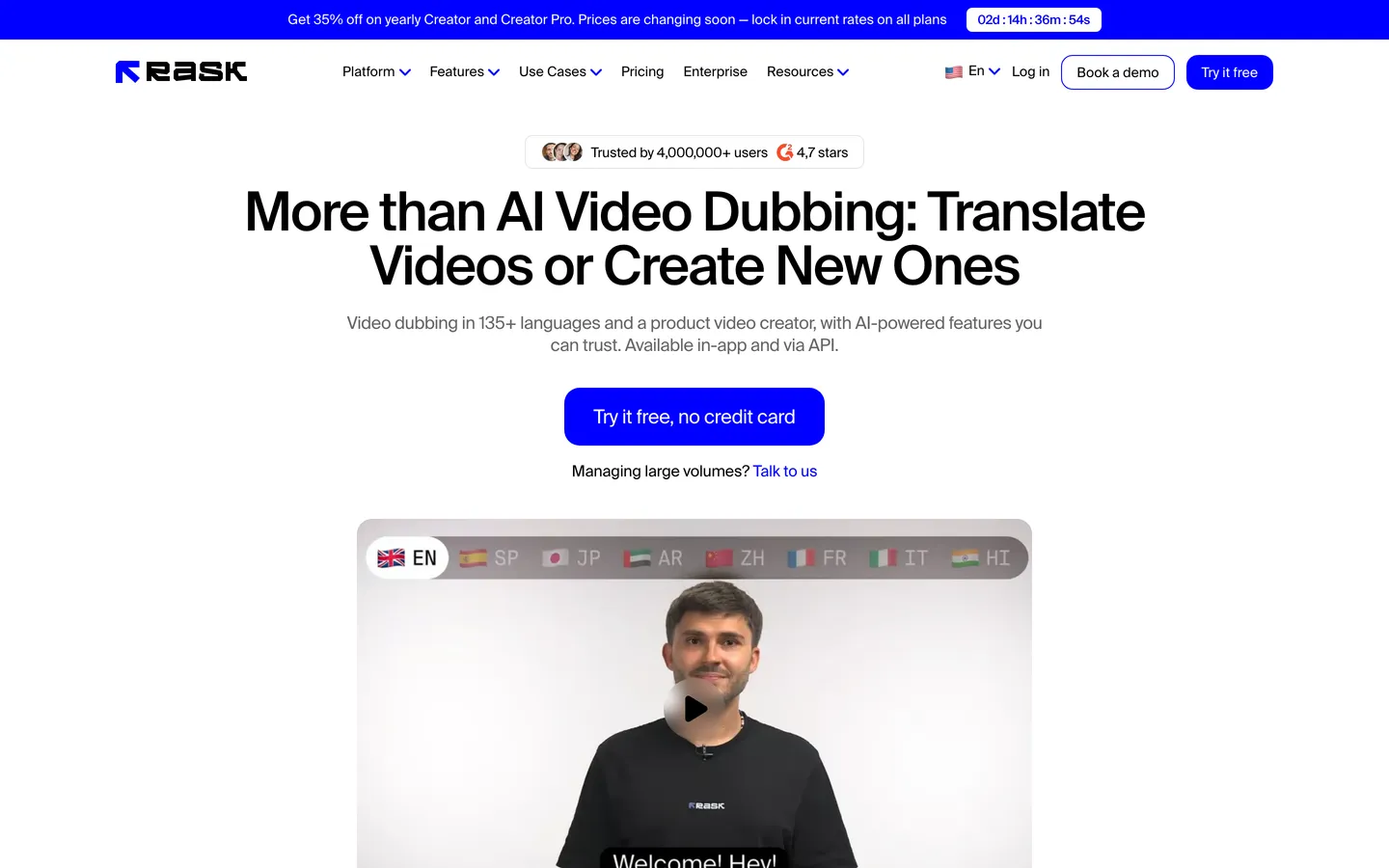
Video translation and dubbing tool that clones the speaker's voice, translates the script and lip-syncs the result in 135+ languages, with a script you can edit before export.
Features
Video translation into 135+ languages: Translates the transcript and generates dubbed audio, including YouTube videos up to 5 hours long
Voice cloning in 32+ languages: Keeps the original speaker's voice in the dubbed track
Lip-sync: Re-times mouth movement to the translated audio, with lip-sync for several speakers on Business and up
Multi-speaker detection: Works out how many people speak and assigns a voice to each
Editable script and Translation Dictionary: Edit the translated transcript, guide the translation style with a prompt and lock in preferred translations for key terms
Subtitles: Automatic captions, SRT upload and download, and a subtitle translator
AI screen recorder (beta): A new Create Video tool
AI models: The models behind translation, cloning and lip-sync aren't disclosed
Scale claim: 4M+ users
Security and compliance: SOC 2 Type II, GDPR and membership of C2PA, the content authenticity standards group
Pricing
How you pay: Monthly subscription that buys minutes of source video, not characters or credits
Free: 3-minute trial, no card needed
Creator: $39/mo
Creator Pro: $99/mo, where lip-sync and the production API start
Business: $249/mo
Enterprise: Custom
Per minute: About $1.00-1.56 on monthly bundles and about $0.67 on annual plans, vs ElevenLabs Dubbing v2 at $2.20 via API
Overage: $3/min
Caveat: The vendor says prices are changing soon
Why it's better than ElevenLabs
Edit the translation before export: ElevenLabs Dubbing v2 users complain it has no script editing or glossary, while Rask offers an editable translated transcript and a Translation Dictionary
Visual lip-sync: Rask re-syncs the speaker's mouth to the new audio, including multi-speaker video on Business, which ElevenLabs doesn't advertise as part of Dubbing
Predictable dubbing cost: Dubbing minutes don't come out of a credit pool shared with TTS, and annual plans work out to about $0.67/min vs $2.20/min for Dubbing v2 via API
More target languages: 135+ languages for translation vs ElevenLabs' 70-90+, though voice cloning covers only 32+
Basic compliance: SOC 2 Type II, GDPR and C2PA membership
What you might lose if you switch
Everything outside dubbing: No general TTS API, Studio long-form editor, Agents, Scribe, Music, sound effects or ElevenReader
No reusable voice library or Professional cloning: No 10,000+ voice library or Professional Voice Cloning quality for use beyond video
Cheapest bulk dubbing: ElevenLabs Dubbing v1 at $0.33/min via API is cheaper than any Rask bundle, and Rask charges $3/min over your allowance
Fewer certifications: No HIPAA, ISO 27001 or FedRAMP
Lip-sync and API cost $99+/mo: Both are locked to Creator Pro and above
VoiceStudio
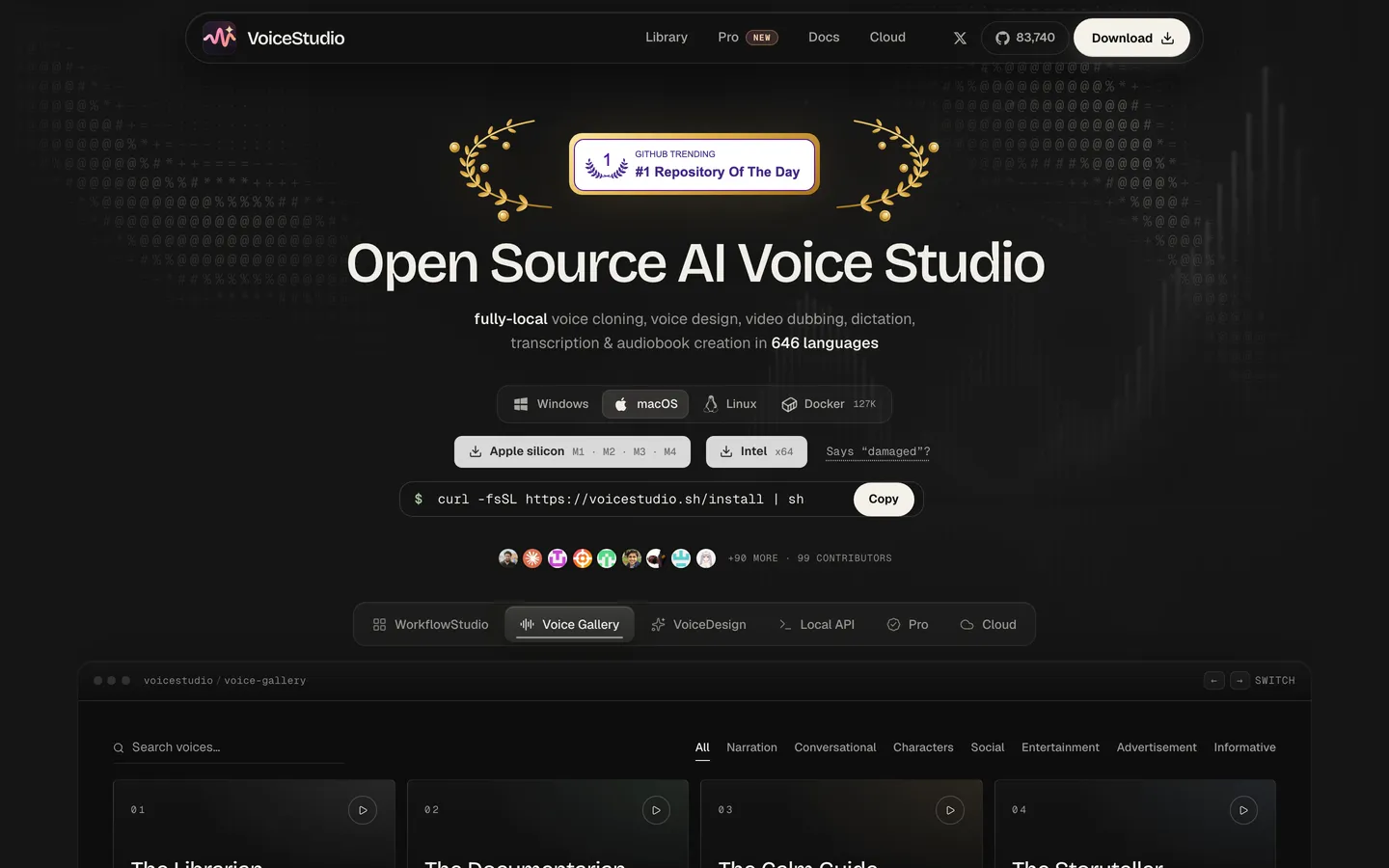
Free, fully local desktop app for voice cloning, voice design, video dubbing, dictation, transcription and audiobooks, with a local API and MCP server for AI agents.
Features
Voice cloning: Clones a voice from a clean reference recording, with checks on audio quality and export precision
Voice design: Builds a new voice from a text description of gender, age, pitch, style and accent, with a fixed setting that keeps the voice identical every time
Video dubbing: Transcribes, translates and re-voices video with timed speech, plus vocal isolation and speaker labelling
Dictation widget: A floating dictation box that works across your whole system, using live sherpa-onnx transcription
Transcription: WhisperX by default, with Faster-Whisper, MLX Whisper, Parakeet TDT, Moonshine and FunASR as options. Claims 646 languages.
Audiobooks and batch jobs: Long-form audiobook and story generation, a batch queue, reusable recipes and watch folders that process new files automatically
Swappable voice engines: A dozen-plus TTS engines including OmniVoice (default), CosyVoice 3, IndexTTS 2.5, MOSS-TTS v1.5, VoxCPM2, GPT-SoVITS, KittenTTS, Supertonic 3 and MLX-Audio, with benchmarks for each
AI watermark: Marks generated audio as AI-made
Privacy: Remote services are opt-in and analytics need your consent
Pricing
How you pay: Free open-source app that runs on your own computer
Free: Everything, with no account, credits or per-minute charges
Cost vs ElevenLabs: Only your hardware and power, vs $40-80 per 1M characters and $2.20/min dubbing
Caveat: The app is licensed AGPL-3.0, and each voice model has its own licence for commercial use
Why it's better than ElevenLabs
No usage costs: No credits to burn on TTS, dubbing or transcription, vs ElevenLabs' $40-80 per 1M characters and $2.20/min for Dubbing v2
Everything stays on your machine: Cloning and dubbing run locally, while ElevenLabs is cloud-only
No platform moderation or bans: No content moderation, cloning verification or account bans. The repo asks users to clone voices only with permission.
Pick newer engines as they ship: Swap in new open models instead of waiting on one vendor's roadmap
Agents can use your cloned voice locally: The MCP server lets coding agents speak in your voice without a cloud service
What you might lose if you switch
Weak emotion control: No equivalent to ElevenLabs v3/v4 expressiveness and inline emotion tags. OmniVoice is rated strong on cloning but weak on emotion.
No voice library or polished editor: No 10,000+ voice library, Professional Voice Cloning or Studio-level polish
No agents, phone, music or ElevenReader: No Agents platform, telephony, Music, sound effects or ElevenReader
Needs strong hardware: A fast NVIDIA GPU or Apple Silicon Mac is needed for usable speed, and Intel Macs can't run it locally
Unclear commercial use and no compliance: AGPL obligations plus a separate licence for each model, and no SOC 2 or HIPAA
Shifting builds: The Tauri version was archived at 0.5.3, and only the Electron build is maintained now
Chatterbox
MIT-licensed open-source text-to-speech family with Original, Turbo, Nano and Multilingual models, zero-shot cloning from a few seconds of audio, built-in watermarking and emotion control.
Features
Zero-shot voice cloning: Clones a voice from a 5-10 second reference clip, with no training step
Emotion exaggeration control: A single setting moves delivery from monotone to dramatic, in the original model
Sound tags: Inline [laugh], [cough] and [chuckle] produce non-speech sounds, in Turbo and Nano
Turbo (350M): English model for low-latency agents, with its audio decoder cut from 10 steps to 1 for speed
Nano (110M): English model for CPU and on-device use, which the vendor says runs about 3x real-time on 8 CPU cores
Multilingual V3 (500M): The newest release, covering 23+ languages, with six dedicated single-language versions including Chinese, Hindi, Spanish and Portuguese
PerTh watermark: Hides an inaudible watermark in every output and ships a script to detect it
Voice conversion: Example scripts restyle existing audio into a target voice
Pricing
How you pay: Free open-source software, where you pay only for your own GPU or CPU
Free: $0 under the MIT licence, with commercial use allowed and no character limits
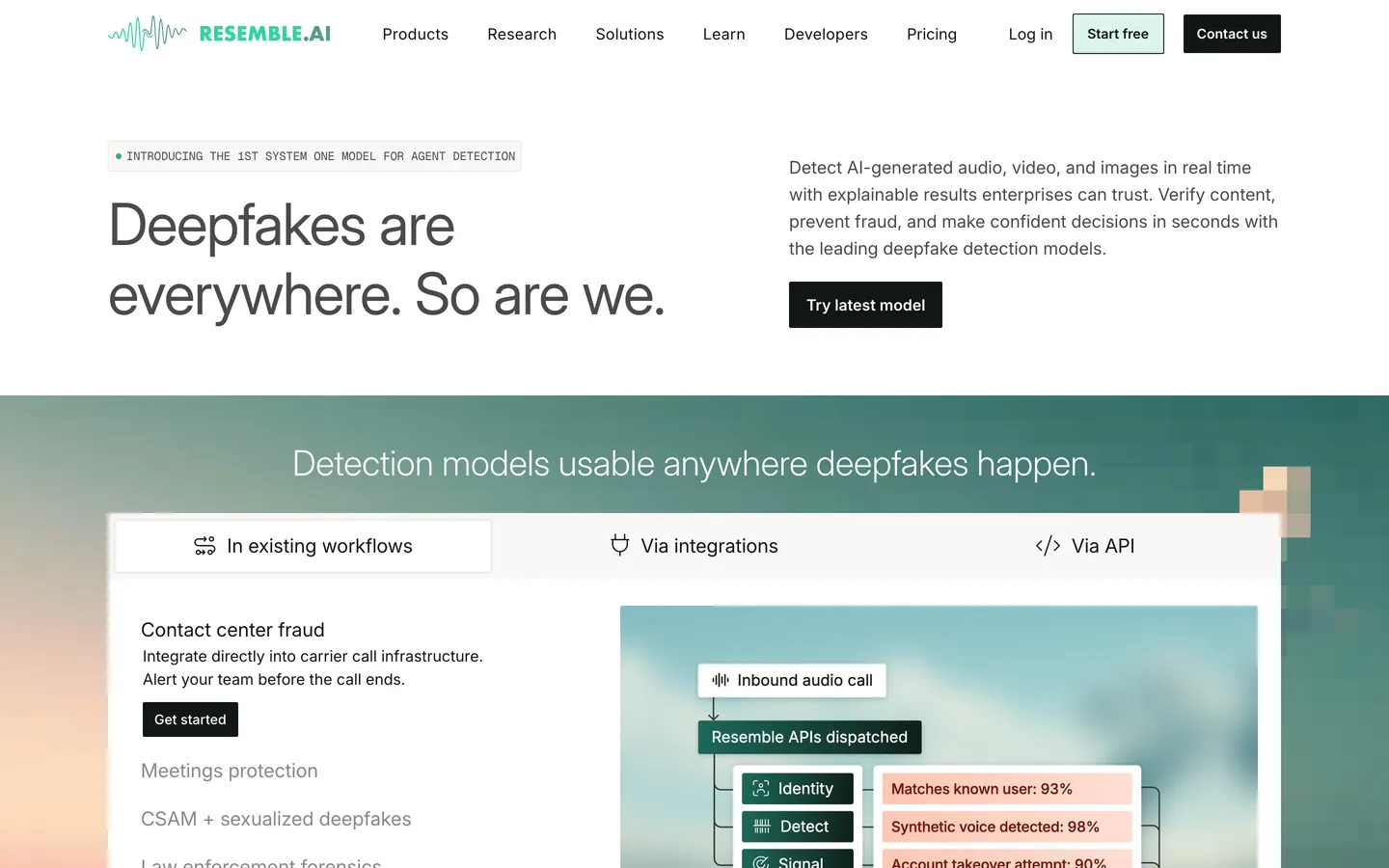
Plans: None for TTS. Resemble's paid plans now cover only deepfake detection.
API: No hosted API for new customers. Self-hosting costs $0 vs ElevenLabs' $40-80 per 1M characters.
Caveat: Resemble left the voice business in August 2026, so there is no vendor support
Why it's better than ElevenLabs
No per-character fees: MIT-licensed weights mean unlimited generation for the cost of your own hardware, vs $40-80 per 1M characters on ElevenLabs' API
Fully on-premise or offline: Voice samples and scripts never leave your machine, and no moderation or cloning verification applies
Free cloning on every model: ElevenLabs needs Starter ($6+) for Instant Voice Cloning and Creator ($22+) for Professional
Preferred in a blind test, per the vendor: In a Podonos blind test on Resemble's own page, 63.75% of listeners preferred Chatterbox over ElevenLabs. This is a vendor-run comparison.
Runs on consumer hardware: Small enough for consumer GPUs, and Nano runs on CPU
What you might lose if you switch
No company behind it: No hosted API for new users, no service guarantee and no committed roadmap
No voice library, Studio, Dubbing or Agents: No 10,000+ voice library, Professional Voice Cloning, Studio long-form editor, Dubbing v2, Music, sound effects, Agents platform, Scribe or ElevenReader
Fewer languages: Turbo and Nano are English-only, and Multilingual covers 23+ vs ElevenLabs' 70-90+
Less expressive and no compliance: No match for ElevenLabs v4 expressiveness, and no SOC 2, HIPAA agreements or FedRAMP
You set it up yourself: Python and GPU tooling are your job

Kokoro
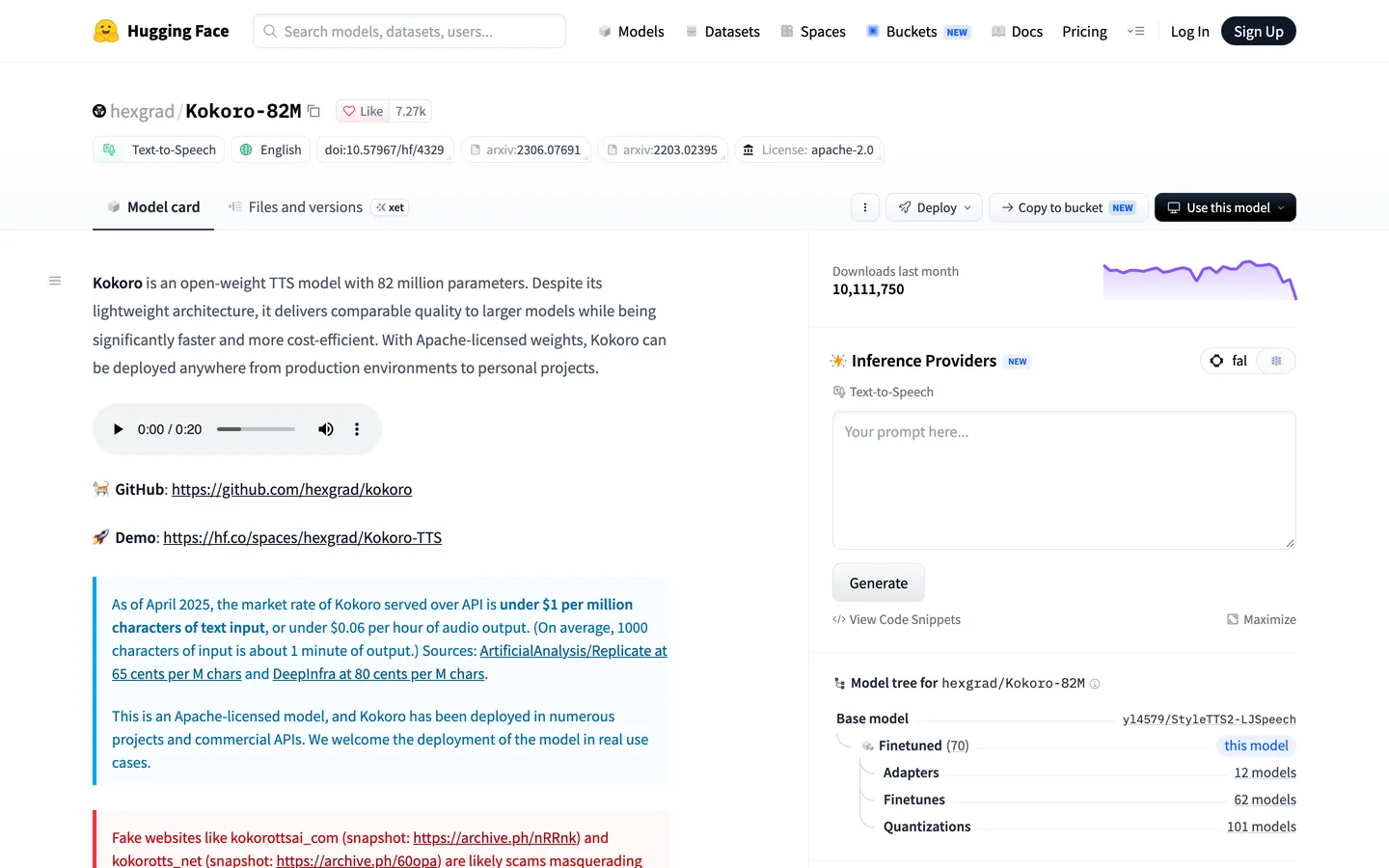
Tiny open-weight text-to-speech model with 54 preset voices in 8 languages, fast enough to render a whole audiobook on a consumer GPU in minutes.
Features
54 preset voices in 8 languages: US and UK English, Spanish, French, Hindi, Italian, Brazilian Portuguese, Japanese and Mandarin in v1.0
Tiny footprint: 82M parameters let it run on CPU, Apple Silicon or modest GPUs
Voice mixing: The Kokoro-FastAPI server blends voices by weight, for example af_bella(2)+af_sky(1), to make new voices
Multi-speaker tags: Inline [voice:...] tags switch speakers within one request
Word-level timestamps: A captioned-speech endpoint returns word timings for subtitles and read-along
Pronunciation control: Phoneme endpoints, IPA pronunciation overrides, pause and speed tags, and experimental SSML markup
Voice tuner (experimental): Nudges a preset toward a 3-30 second reference clip. The README calls it a tuner, not a cloner.
Model version: v1.0 weights released January 27, 2025 and still widely used, based on the StyleTTS2 model
Pricing
How you pay: Free open weights to self-host, or cheap per-character hosted APIs
Free: $0 self-hosted under Apache-2.0, with commercial use allowed
DeepInfra: $0.99 per 1M characters, roughly 40-80x cheaper than ElevenLabs' $40-80
Replicate: About $0.0002 per run
Why it's better than ElevenLabs
Far cheaper: Under $1 per 1M characters hosted vs ElevenLabs' $40-80 per 1M, and free self-hosted with no credit pool to burn
Very fast: Kokoro-FastAPI reports 35-100x real-time on an RTX 4060 Ti, and one user produced 120 hours of audio in 1.5 hours on an AMD 7900 XTX
Free commercial use and private audio: Apache-2.0 weights allow commercial use with no subscription, and audio stays on your hardware
Runs without a big GPU: Works on CPU or Apple Silicon, where most rivals need a large GPU
What you might lose if you switch
No voice cloning at all: No Instant or Professional Voice Cloning
Only 54 preset voices and less emotion: The 10,000+ voice library shrinks to 54 presets, and you lose v4's emotional range
No Studio, Dubbing, Agents or transcription: No Studio long-form editor, Dubbing v2, Music, sound effects, Agents platform, Scribe or ElevenReader
Only 8 languages: Down from ElevenLabs' 70-90+
No compliance or support: No SOC 2, HIPAA or FedRAMP, and no vendor service guarantee when self-hosting
Qwen3-TTS
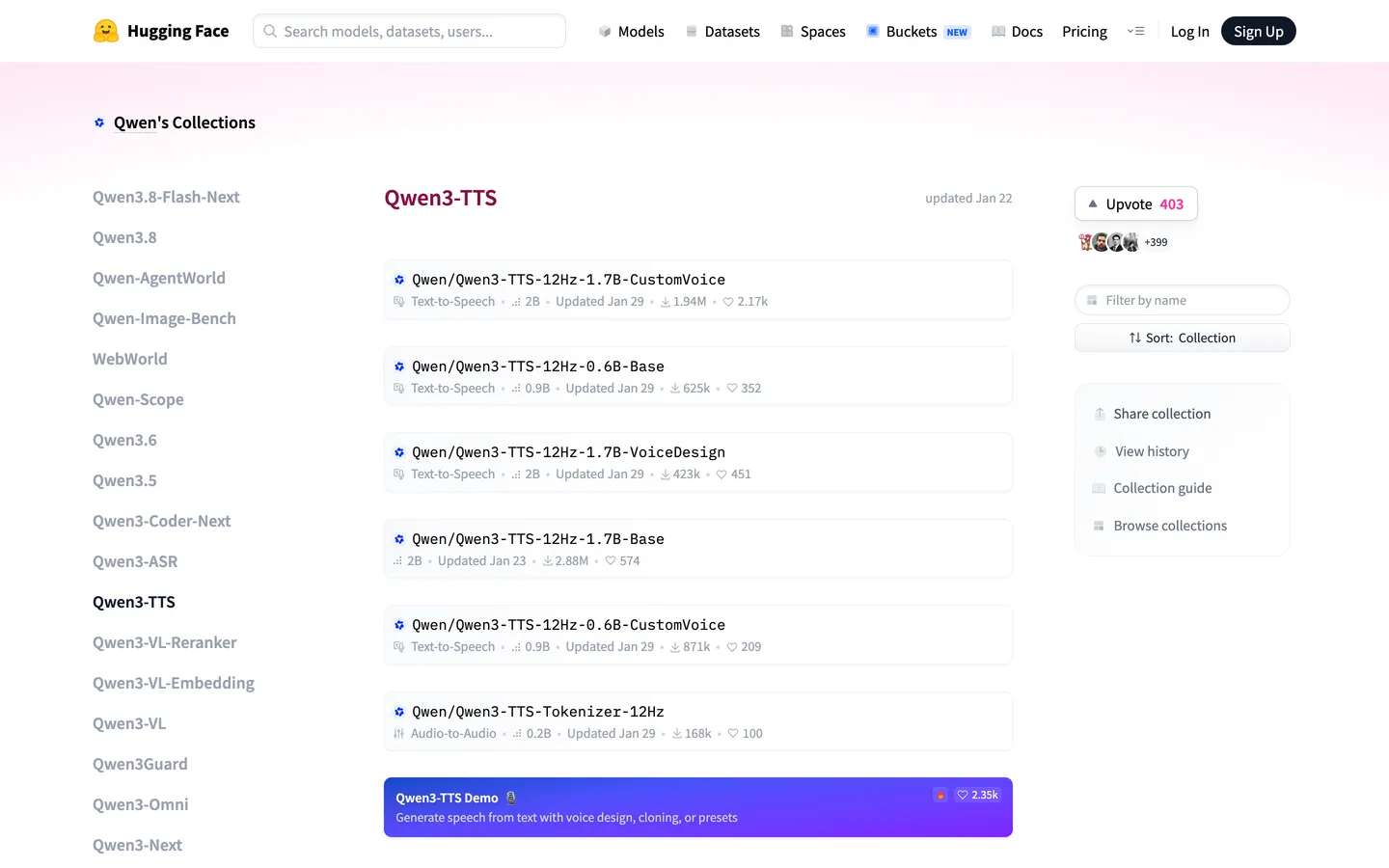
Alibaba Qwen's open-weight text-to-speech models in 0.6B and 1.7B sizes, with 3-second voice cloning, voice design from a text description and streaming latency as low as 97ms, plus a paid API on Alibaba Cloud.
Features
3-second voice cloning: The Base models clone from about 3 seconds of reference audio, and you can save and reuse a clone
Voice design: Creates a new voice from a plain-language description with the 1.7B VoiceDesign model, and can be combined with cloning
CustomVoice presets: Built-in speakers that follow style instructions for tone and emotion
10 languages: Chinese, English, Japanese, Korean, German, French, Russian, Portuguese, Spanish and Italian, plus Chinese dialects
Low-latency streaming: First audio can start after one character, with end-to-end latency as low as 97ms per the vendor
Fine-tuning: The Base models can be trained further on your own data
Release: Open weights released January 22, 2026 and the Model Studio API is generally available. Uses a 12Hz tokenizer.
Pricing
How you pay: Free open weights to self-host, or a pay-per-character Alibaba Cloud API
Free: $0 self-hosted under Apache-2.0. The API gives 110K free characters for 90 days.
API: $10 per 1M characters, or $13 for real-time, vs ElevenLabs' $40-80
Voice cloning: $0.01 per cloned voice on the API
Caveat: Chinese, Japanese and Korean characters are billed as two characters each
Why it's better than ElevenLabs
Lower API price: $10 per 1M characters vs ElevenLabs' $40-80, and cloning at $0.01 per voice with no plan-tier requirement
Self-hostable under Apache-2.0: Voices and scripts stay local, with no credits or moderation bans
Voice design and 3-second cloning in open weights: Both are free to run yourself
Better benchmark scores, per the vendor: Qwen's own benchmarks show lower word error rates than ElevenLabs in 7 of 10 languages and closer speaker likeness in all listed languages
Handles long passages: One creator reads a full PDF page per pass on a 12GB laptop
What you might lose if you switch
Flat emotional range: Users find it flat next to ElevenLabs v3/v4
Only 10 languages: Down from ElevenLabs' 70-90+
No voice library, Studio, Dubbing or Agents: No 10,000+ voice library, Studio long-form editor, Dubbing v2, Music, sound effects, Agents platform, Scribe or ElevenReader
No compliance certifications: No SOC 2, HIPAA agreements or FedRAMP, and the API runs in Alibaba Cloud regions instead
Technical setup and re-rolls: A local install needs a GPU, Python and FlashAttention setup, and occasional glitches mean regenerating
MimicMe
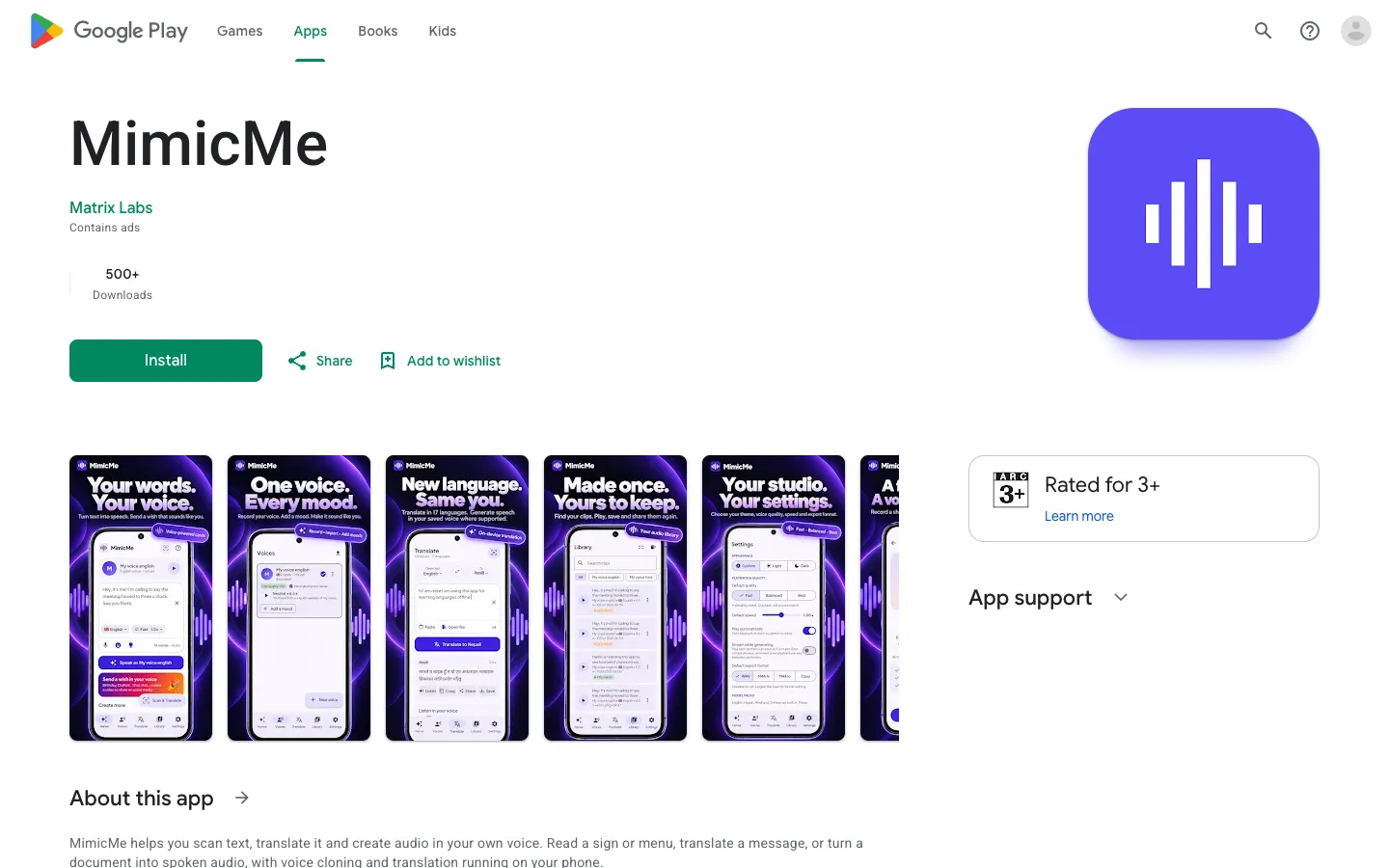
A free Android app that clones your voice from a few seconds of recording and reads any text, document or scanned sign aloud in it, with cloning, text recognition and translation all running offline on the phone.
Features
Voice cloning from a short sample: Record a few seconds of your voice or import an audio clip to create a saved voice. The app keeps a compact voice profile worked out from the clip on your phone, with no copy of your voice in the cloud.
Reader mode for documents: Opens documents through the phone's file picker and reads them aloud in your saved voice, even in the background. Playback controls sit in the notification, and a recent list remembers how far you got in each document.
Studio for text to speech: Type, paste or dictate text (dictation is English) and turn it into speech, with Warm, Excited, Calm, Serious and Storyteller moods to choose from.
Your voice as the phone's reading voice: MimicMe can be set as Android's text-to-speech engine, so compatible apps read text in your cloned voice.
Scan and translate: Point the camera at a sign, menu, label or printed page, or use a photo, and the app reads the text, translates it into any of 67 languages and speaks the result in your voice where that language is supported. It reads Latin and Devanagari (Hindi and Nepali) scripts.
Document translation in 17 languages: English, Nepali, Hindi, Urdu, Bengali, Marathi, Maithili, Bhojpuri, Gujarati, Punjabi, Odia, Assamese, Tamil, Telugu, Kannada, Malayalam and Sanskrit.
Works offline once set up: Voice cloning, text recognition and translation run on the phone. After you've downloaded the voice and translation models, these features work without an internet connection.
Audio editing and export: Trim and adjust the audio it generates, then save or share it as a WAV or M4A file.
AI-audio watermark and checker: Every clip gets a watermark you can't hear, and the Verify screen checks any audio file for it, so you can tell whether a clip was made with the app.
Consent checks on imported voices: An imported clip has to match a fresh recording of you, or be flagged as another person's voice used with their permission. The app stores that consent record with the voice.
Encrypted voice packs: Export a voice's sample clips and their transcripts as a pack, with an optional passphrase to lock it.
Voice greeting cards: Makes celebration cards with a photo and a message in your voice, saved as videos to watch and share later. This was added in the November 2026 update.
Pricing
MimicMe is free and paid for by ads. Google Play lists no subscription and no in-app purchases.
Free: $0. Every feature is included, with no account and no subscription.
Ads: Shown through Google's AdMob ad network. A small ad appears while audio or a card is being made, and now and then a full-screen ad appears after you leave a finished card or save a clip. Ads never play while you're recording or listening.
Ad-free: Watching one optional video ad removes ads for 24 hours. No paid ad-free option is listed.
Why it's better than ElevenLabs
Free cloning, no account: Voice cloning is included in the free, ad-supported app with no sign-up. ElevenLabs puts Instant Voice Cloning on its $6 a month Starter plan.
Runs on your phone: Cloning, text recognition and translation run on the device, so they work offline once the model packs are downloaded. ElevenLabs generates everything in the cloud.
Scan and hear it: Point the camera at a sign, menu or printed page, translate it into one of 67 languages and hear it read in your own voice where that language is supported.
Nepali and Hindi built in: Voice generation covers Nepali and Hindi alongside English, and documents translate across 17 languages, most of them South Asian.
Your voice in other apps: MimicMe can be set as Android's text-to-speech engine, so compatible apps read aloud in your cloned voice.
What you might lose if you switch
Few voice languages: Speech comes in English, Nepali and Hindi plus a few optional packs, while ElevenLabs lists 74 languages for text to speech.
Android phone only: It needs a 64-bit phone on Android 8.0 or newer. There's no web app, desktop version or API, and no iPhone version is listed.
Ads you can't pay to remove: Ads show while audio is being made and sometimes full screen after you save a clip. A rewarded video turns them off for 24 hours, and no paid ad-free option is listed.
Far fewer tools: There's no voice library, Voice Design, Professional Voice Cloning, dubbing, music or sound effects, and delivery control is limited to five mood presets.
New and untested: It comes from Matrix Labs in Kathmandu, whose privacy policy dates from October 2026. It has 500+ downloads, no ratings or reviews yet, and no published terms for commercial use of the audio.