
Fish Audio
Low-cost text-to-speech and voice cloning API built on its own open-weights Fish Speech models that you can also run on your own GPU.
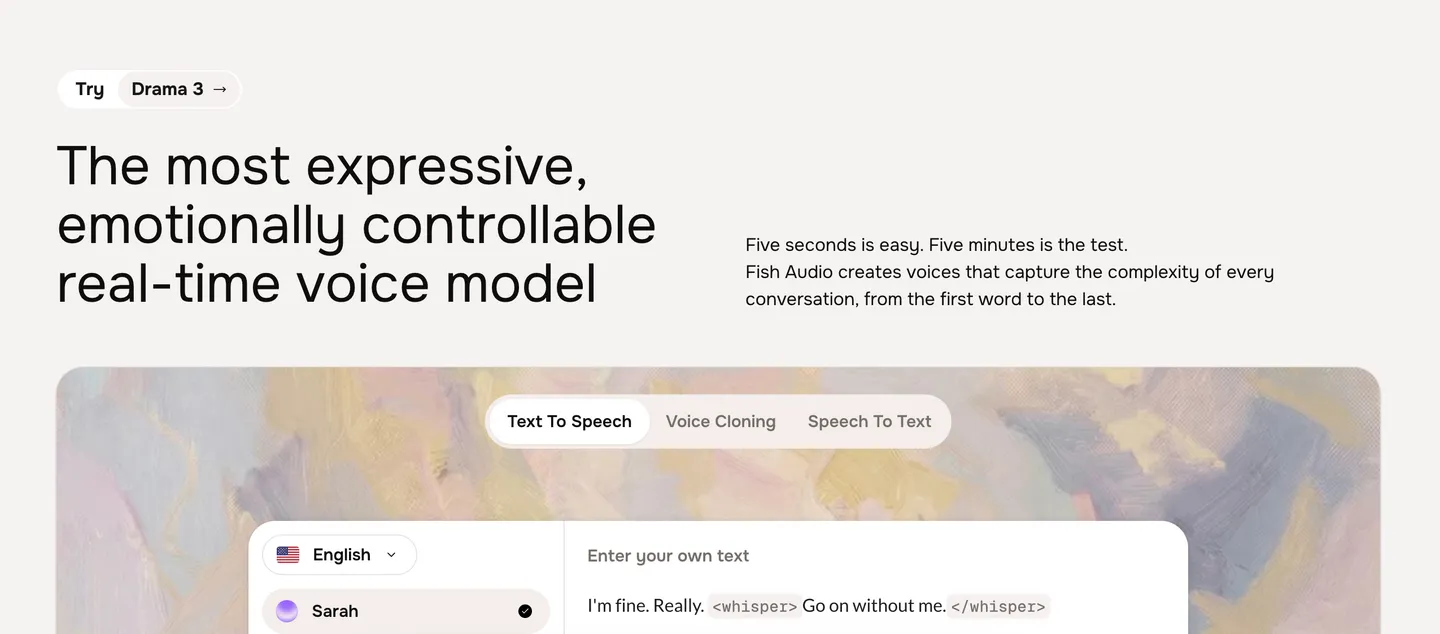
Short description
Fish Audio is a text-to-speech and voice cloning service that turns text into lifelike speech and clones a voice from a short sample, at a much lower price per character than ElevenLabs. Creators use the web app for voiceovers and narration while developers either call its API or download the model to run privately on their own hardware.
Features
Zero-shot voice cloning: Clones a voice from 10-30 seconds of reference audio with S2 Pro, with no training step
Inline emotion and pacing tags: Tags such as [pause], [excited], [whisper] and [laughing] change delivery mid-sentence
80+ languages: S2 Pro lists 80+ languages, with Japanese, English and Chinese as its strongest
Real-time streaming: WebSocket streaming for voice agents, with about 100ms to first audio on an H200 GPU, per the vendor's figure for S2 Pro
Voice Design API: Generates candidate voices from a text description
Community voice library: Unlimited public voices on paid plans
Models: s2.1-pro on the API, S2 Pro open weights released in 2026, and the newer Drama 3 open release on GitHub, a 35B mixture-of-experts model
Security and compliance: SOC 2 on Enterprise only
Pricing
How you pay: Monthly credit plans for the web app, or pay-as-you-go for the API
Free: $0, about 7 minutes of audio a month, non-commercial
Plus: $11/mo
Pro: $75/mo, up to 1,620 minutes of audio
Max: $749/mo
Enterprise: Custom
API: $15 per 1M bytes, about 1M English characters, vs ElevenLabs' $40-80 per 1M characters
Self-host: Free open weights. The S2 Pro model needs a paid licence for commercial use.
Integrations
Self-hosting options: Docker, a command-line tool, a web interface and an API server, plus setup recipes for the SGLang-Omni and vLLM-Omni serving tools. S2 Pro has 5B parameters, and users report it needs about 8.8 GB of GPU memory and runs about 3x real-time on an RTX 5090.
Developer SDK: Official Python SDK, with raw REST and WebSocket for other languages
Voice agent frameworks: LiveKit Agents plugin (s1 and s2-pro models) and Pipecat's FishAudioTTSService let you use Fish voices in real-time voice agents
Downloads: Code at github.com/fishaudio/fish-speech and weights at huggingface.co/fishaudio/s2-pro, with API docs at docs.fish.audio
Platforms
- Web app
- REST and WebSocket API
- Self-hosting on your own machine or server
- Enterprise on-premise
What users love about Fish Audio
Clones that beat ElevenLabs v3 on likeness: S2's zero-shot and professional clones match the speaker more closely than ElevenLabs v3, and it builds a usable voice from about 10 seconds of audio, even on the free demo
Whole scripts in one pass: A full voiceover script generates in one go without line-by-line re-tweaking. One creator used it daily for two months this way.
ElevenLabs-level quality at $15 per 1M characters: Quality is comparable to ElevenLabs for far less money, and a 15-year TTS user made it their default for speed and price
Same output hosted or local: Fish Speech run locally, for example to turn study material into podcasts in favourite voices, matches the hosted output. A developer gateway serving 15,000+ developers reports it stable at scale.
What users complain about Fish Audio
Free tier too small to compare tools: The free credits run out before you can properly test it against other tools
Emotion tags silently don't work on the free tier: The tags look available but do nothing, so testers can't tell whether a feature is broken or locked to paid plans
Poor Spanish output: The same users praising its English cloning rate its Spanish as very poor, so multilingual projects need to test their languages first
Best model needs a powerful GPU: S2 Pro needs about 8.8 GB of GPU memory and runs about 3x real-time on an RTX 5090, slower than lighter open models
First clone may not sound like you: Some clones need settings adjusted before they match, and a few users hit odd voice artifacts that wasted credits
Similar tools
Alternative AI options