Kilo Code
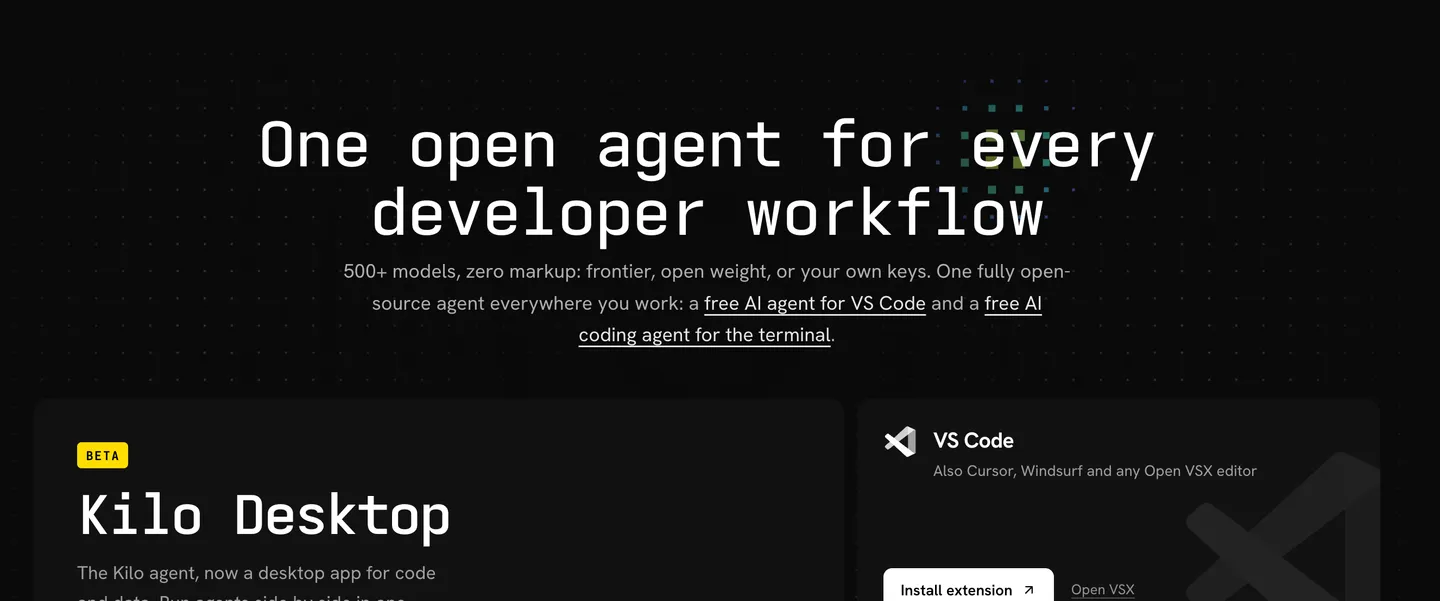
Open-source agentic engineering platform that gives you 500+ models at zero markup under an MIT license.
Short description
Kilo Code is an MIT-licensed, open-source AI coding platform that works across IDEs, the terminal, and cloud agents. Its biggest selling point is model flexibility: choose from 500+ models, bring your own API keys, or use Kilo's model gateway with zero AI inference markup. Acquired by Anaconda in July 2026, Kilo continues to operate with its existing products and plans. It has 27.5k GitHub stars, 5M+ users, 10T+ tokens processed monthly, and was recognized as “#1 Open Source Product of the Month”.
Features
Specialized agents: Switch between Code, Plan, Debug, Ask, and custom agents for different tasks.
Auto Model: Automatically selects a model strategy based on task complexity and your chosen cost tier: Frontier, Efficient, or Free.
Cloud Agents: Delegate long-running tasks to remote agents that can work on repositories, run commands, and prepare changes while your local machine is free.
Agent Manager: Run multiple agents side by side and track their work from a central interface.
Kilo Gateway: Access 500+ models through a unified endpoint, with provider-level pricing and no added inference markup.
Code Reviews: Run AI-powered reviews on pull requests or local changes to identify bugs and suggest improvements.
Security Agent: Analyze potential vulnerabilities and validate exploitability to help prioritize real security risks.
Kilo for Slack: Ask questions about repositories, request code changes, and launch cloud agents directly from Slack.
Mobile apps: Monitor cloud agents, review pull requests, and interact with coding sessions from iOS and Android.
MCP and custom integrations: Connect external tools and extend the agent's capabilities.
Pricing
Free / open-source: MIT-licensed core coding agent.
Auto Free: $0; routes requests to available free models.
Bring your own keys: Use your own model-provider API keys or compatible local models.
Kilo Gateway: Pay-as-you-go access to 500+ models at provider rates, with no inference markup.
Kilo Pass: Starts at $19/month, with bonus credits on eligible plans.
No mandatory per-seat fee for individual use: The core agent is free; hosted inference, cloud compute, and team or enterprise features may cost extra.
Integrations
Models: 500+ models across 60+ providers, including frontier, open-weight, and supported local models.
AI providers: Bring your own Anthropic, OpenAI, Google, Azure, AWS Bedrock, and other supported provider credentials.
MCP: Connect external tools and services.
GitHub and other code hosts: Integrate repositories and pull-request workflows; cloud-agent support also includes GitLab and Bitbucket, subject to configuration and plan
Platforms
- VS Code
- JetBrains IDEs (IntelliJ
- PyCharm
- WebStorm)
- CLI
- cloud agents
- desktop
- mobile
- and Slack.
What users love about Kilo Code
Transparent, no-markup pricing: Users can see model usage costs and choose providers based on their budget. This makes it easier to experiment with different models without paying an additional inference premium.
Choice of models: Access to hundreds of models lets developers balance coding quality, speed, and cost. They can use a more capable model for difficult tasks and a cheaper one for simpler edits.
Fine-grained control: Developers appreciate being able to configure agents, select models, customize workflows, and inspect changes rather than treating the assistant as a black box.
Multiple development environments: Native JetBrains support is valuable for developers who prefer IntelliJ, PyCharm, or WebStorm over VS Code.
Cloud-agent workflows: Users can delegate longer tasks and check progress remotely instead of keeping every task tied to their local machine.
Free entry point: The free core, available free models, and bring-your-own-key option let developers try Kilo without committing to a paid inference subscription.
What users complain about Kilo Code
Unexpected AI costs: Even with no markup, complex tasks can consume substantial tokens. Some Reddit users report that a single task cost more than expected compared with a fixed-price coding subscription.
Context and instruction-following issues: Some users report agents forgetting instructions, modifying files they were told not to touch, or losing track of earlier work.
Regression in familiar workflows: Following major interface and workflow changes, some long-time users have complained about reduced visibility into agent plans, diffs, and model configuration.
Learning curve: The many models, agents, settings, and billing options can take time to understand, especially for beginners.
Uncertain roadmap: Some users remain unsure how the Anaconda acquisition will affect Kilo's independence, features, and pricing over time.
Similar tools
Alternative AI options