
OpenCode
Open-source AI coding agent that runs in your terminal, IDE or desktop app.
Short description
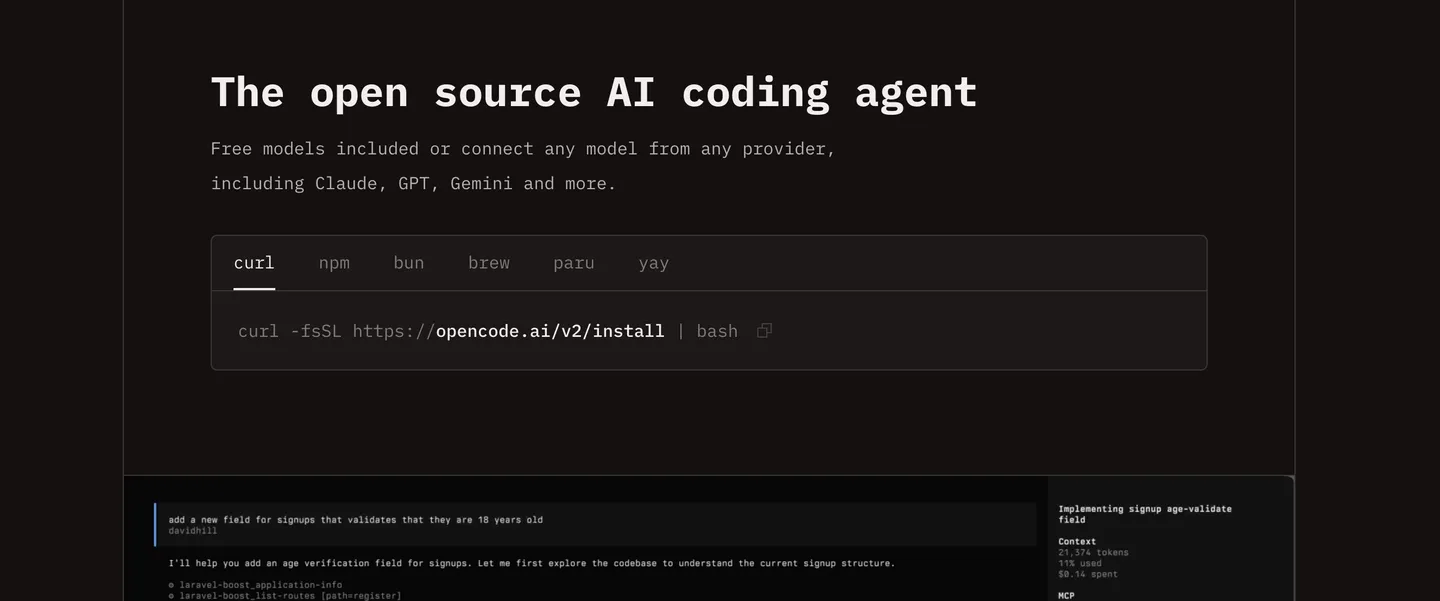
OpenCode is the biggest open-source terminal/desktop coding agent (by Anomaly, formerly SST). It is a free, privacy-first Cursor alternative that is live and extremely active (208k GitHub stars, 950 contributors, 16M monthly devs).Instead of locking you into one AI provider, it lets you connect models from dozens of providers, use supported existing subscriptions, or run local models. It works through a terminal interface, a desktop app, and editor integrations, making it an alternative to Cursor for developers who want more control over their coding setup.
Features
75+ model providers: Switch between supported models from OpenAI, Anthropic, Google, and other providers without changing coding tools.
Built-in LSP support: Uses Language Server Protocol integrations to access code intelligence, such as diagnostics and symbol information, beyond plain-text code.
Multiple sessions: Run separate coding sessions for different tasks and switch between them without losing their individual conversation histories.
Terminal and desktop interfaces: Use the command-line interface for a keyboard-driven workflow or the desktop app for a graphical experience.
Shareable sessions: Generate links to share coding sessions with teammates or use them to explain a debugging problem.
Local models: Connect supported local models through tools such as Ollama, allowing coding workflows that do not require sending prompts to a cloud model provider.
Customizable agents: Configure agents, prompts, commands, tools, and MCP servers to suit your development workflow.
OpenCode Zen: Access a curated selection of models tested by the OpenCode team, with the aim of reducing the guesswork involved in choosing a provider and model.
Pricing
Free / open-source: $0 for the software itself.
Bring your own API key: Pay the model provider based on its pricing and your usage.
OpenCode Go: $10/month for access to supported open coding models, subject to usage limits.
OpenCode Zen: Optional access to curated, tested models with provider-specific pricing.
Integrations
LLM providers: 75+ providers via Models dev, including local models
GitHub Copilot & ChatGPT Plus/Pro: Reuse your existing subscription
LSP servers: Language-aware code understanding
What users love about OpenCode
Free model promotions: Limited-time access to free models gives users a way to test new releases and run coding tasks without immediately committing to a paid plan.
OpenCode Go's value: Developers praise the $10/month subscription for access to a curated range of coding models, including DeepSeek, Qwen, Kimi, and GLM. It offers an affordable way to experiment with different models under one subscription, although usage limits vary by model.
Freedom to choose models: Developers appreciate switching between providers and using different models for planning, implementation, and code review.
Open-source flexibility: Users value the ability to customize their setup and avoid being locked into one proprietary editor.
What users complain about OpenCode
Configuration can be overwhelming: New users may struggle with provider authentication, model selection, configuration files, and choosing the right model for a task.
Desktop app stability: Some users have reported missing models, lost-looking conversations, and other desktop issues. These reports are anecdotal and may depend on the app version and operating system.
Usage limits and provider reliability: OpenCode's flexibility cannot prevent a connected provider from throttling requests, changing limits, or experiencing outages. Users of subscription-based model bundles have also complained about restrictive quotas.
Uneven results across models: Switching to a cheaper model can save money but may require more retries, debugging, or manual intervention. Some users find that the best-value model is not necessarily the best at complex coding tasks.
Not as turnkey as Cursor: Developers who want autocomplete, visual editing, debugging, and AI assistance tightly integrated into one polished IDE may prefer Cursor's more unified experience.
Similar tools
Alternative AI options