OpenRing
An open-source voice AI agent platform you host yourself, with a Vapi-compatible API, that answers and places phone calls over Twilio, Telnyx, Plivo, Vonage or SIP using your own provider keys or a free local stack, and charges no per-minute platform fee.
Short description
OpenRing runs AI phone agents and AI receptionists on your own computer or server. Each call goes through a pipeline built on Pipecat, an open-source voice framework: the caller's speech becomes text, a language model writes the reply (and can call your tools), and a voice reads it back. You choose each step. Speech-to-text can be Deepgram, AssemblyAI or Whisper running locally; the model can come from OpenAI, Anthropic, Groq, Ollama or about a dozen other providers; and the voice can be ElevenLabs, Cartesia, Deepgram Aura or Kokoro, a free voice that runs on your CPU.
The project is built around compatibility with Vapi. It reads the same assistant JSON, provider names, tool calls and webhooks, so a Vapi client can switch by changing its base URL, and an Import button copies a Vapi account's assistants, tools, squads and Twilio numbers. Hosted platforms charge a fee for every minute of every call. OpenRing charges nothing, and you pay each provider directly. Run Whisper, Ollama and Kokoro together and the only per-minute cost left is the phone line.
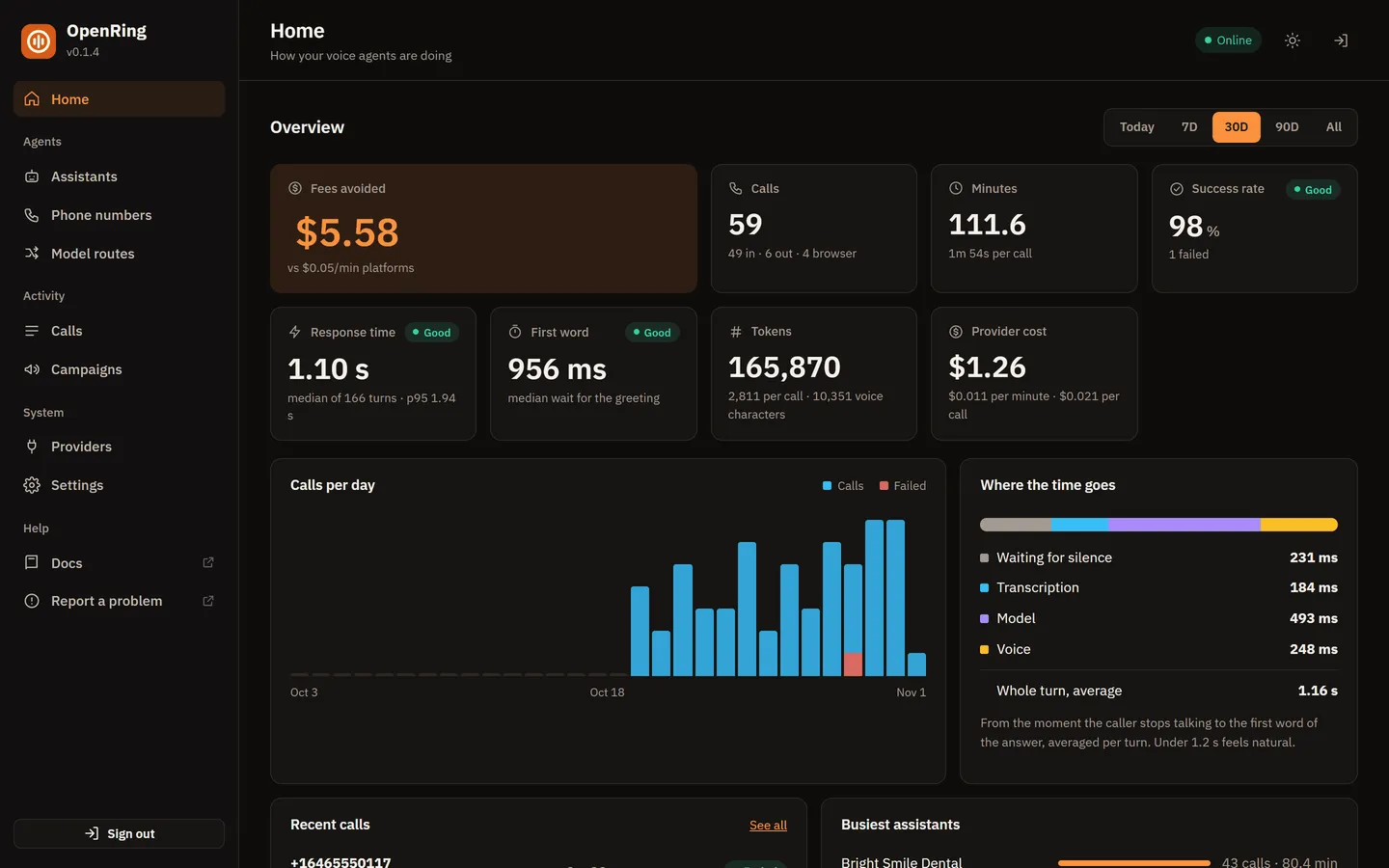
You install it with one command, npx openring, which opens a dashboard showing calls, transcripts, response time per turn and what each provider charged. OpenRing is MIT licensed, first released on October 30, 2026, and made by Alan Rocha of Real Valor, a technology company in São Paulo, Brazil. It is at version 0.1.7, and Twilio is the only carrier tested on real calls so far.
Features
Vapi-compatible API: Uses Vapi's assistant JSON, provider names, tools, webhooks and end-of-call report, so an existing Vapi client works once you point it at your own server's address.
Import from Vapi: Copies every assistant, squad, tool and Twilio number from a Vapi account in one request or with the Import button. The Vapi key is used once and never stored, and the result lists anything that still stops an assistant from taking calls.
Free local stack: Whisper for speech-to-text, a model through Ollama and the Kokoro voice all run on your machine with no API key and no per-minute cost, and the call audio stays on your computer. The assistant editor sets this up with one button.
Test calls in the browser: Press Test in the dashboard and talk to an assistant through your microphone before you buy a phone number.
Phone lines and SIP: Takes and makes calls over Twilio, Telnyx, Plivo and Vonage, connects to any carrier through a SIP trunk (a direct phone-line connection), and answers inbound calls inside Genesys Cloud contact-center flows. Only Twilio has handled real calls; the rest are in beta and were tested against simulated carriers.
Backup providers mid-call: If the speech, model or voice provider fails during a call because of a rejected key, empty credit or an outage, the next one on your list takes over for the rest of the call. The backup model can come from a different company.
Model routes: Saved lists of models that several assistants share, with Fastest, Cheapest, Reliable and Custom presets. A route moves to the next model when one hasn't started answering within 1.5 to 3 seconds, and rests a failing model for 5 to 15 minutes. Speech-to-text and voices can have routes ordered by price.
Cost of every call: Records what each provider charged at list prices, covering the model, speech-to-text, the voice and the Twilio line for US and Canadian numbers, and shows it per call and per minute. You can add your own rates in a prices file.
Calling campaigns: One assistant works through a pasted list or a CSV a few calls at a time, inside a time window you set, and calls back busy or unanswered numbers up to 5 times, 5 to 1,440 minutes apart. It warns you when calls could reach people outside the hours US law (the TCPA) allows.
Squads, tools and knowledge bases: Hands a call between several assistants (beta), lets the model end or transfer calls and send requests to an n8n, Make or Zapier webhook, and answers from your files with a word-matching search that runs on your own server (beta).
Call controls: Optional stereo recording (off by default and deleted after 365 days unless you change it), voicemail detection on outgoing Twilio calls (beta), limits on call length and silence, an "Are you still there?" prompt, and a list of names the transcriber should get right.
Callers in any language: "Follow the caller" detects the caller's language and tells the model to reply in it, switching when the caller does. ElevenLabs and OpenAI voices read any language; Kokoro and Deepgram voices speak one each.
Pricing
OpenRing: Free and open source under the MIT license, with no platform fee, no per-minute charge and no paid plan.
Your providers: You pay the speech-to-text, model, voice and phone companies directly at their own prices, through your own keys.
Local stack: Whisper, Ollama and Kokoro cost nothing per minute. Only a real phone line costs money; browser test calls are free.
Hosting: Runs on your own computer or server. The project ships a Docker image plus Render and Railway setups, but the server bill, uptime and any compliance work are yours.
Donations: Optional support through Patreon, or Pix in Brazil.
Integrations
Phone carriers: Twilio (tested on real calls), Telnyx, Plivo, Vonage and SIP trunks (beta, calls in and out), and Genesys Cloud through its Audio Connector (incoming calls only).
Model providers: OpenAI, Anthropic, Google Gemini, Groq, OpenRouter (with one-click sign-in), DeepSeek, xAI, Cerebras, Together AI, DeepInfra, Perplexity, Mistral and Fireworks. For local models, Ollama, OmniRoute or any service that accepts OpenAI's request format.
Speech-to-text: Deepgram, AssemblyAI, Gladia, Soniox, Cartesia and ElevenLabs, or Whisper on your own machine in sizes from tiny to large-v3-turbo.
Voices: ElevenLabs, Cartesia, Deepgram Aura, OpenAI, Rime, Neuphonic, Smallest AI and Inworld, or Kokoro on your own machine.
Automation webhooks: The apiRequest tool lets the model fill in a request and send it to n8n, Make, Zapier or any URL you choose.
Deploy options: A Docker image on GitHub's container registry, a one-click Render blueprint, a Railway config and automatic address setup on Fly.io.
Platforms
- Self-hosted
- web dashboard
- REST API
Frequently asked questions about OpenRing
Is there an open-source alternative to Vapi?▼
Yes. OpenRing is an MIT-licensed voice agent platform you host yourself, and it was built to match Vapi's API. It reads the same assistant JSON, provider names, tools and webhooks, so a Vapi client moves over by changing its base URL. The Import button copies a Vapi account's assistants, tools, squads and Twilio numbers in one step.
Can you run an AI voice agent for free?▼
Yes, on your own computer. In OpenRing, Whisper for speech-to-text, a model through Ollama and the Kokoro voice cost nothing per minute and need no API keys. Test calls from the browser are free too. You only pay once you connect a real phone line, and a Twilio trial account is enough for testing.
How do you connect an AI agent to a phone number?▼
In OpenRing, you create an assistant, add a number from Twilio, Telnyx, Plivo or Vonage, and point that number's voice webhook at your OpenRing server's public https address. For Twilio the webhook goes to /twilio/voice, and incoming calls need your Twilio auth token so OpenRing can check that each request really came from Twilio. Twilio is the only carrier tested on real calls so far; the others are in beta.
Is OpenRing cheaper than Vapi per minute?▼
OpenRing has no platform fee. Its own comparison, checked November 8, 2026, lists Vapi at US$0.05 a minute and Retell at US$0.055 a minute on top of provider costs. On any of these platforms you still pay for the model, the voice, the phone line and usually speech-to-text. With OpenRing you also pay for and look after the server.
Do I need Docker or a GPU to run OpenRing?▼
No. npx openring needs Node.js 18 or later and installs everything else, Python included, then opens the dashboard at localhost:8000. A graphics card makes the local stack faster, and cloud providers need none. Docker is available if you'd rather run it on a server.
Similar tools
Alternative AI options