
Kokoro
Tiny open-weight text-to-speech model with 54 preset voices in 8 languages, fast enough to render a whole audiobook on a consumer GPU in minutes.
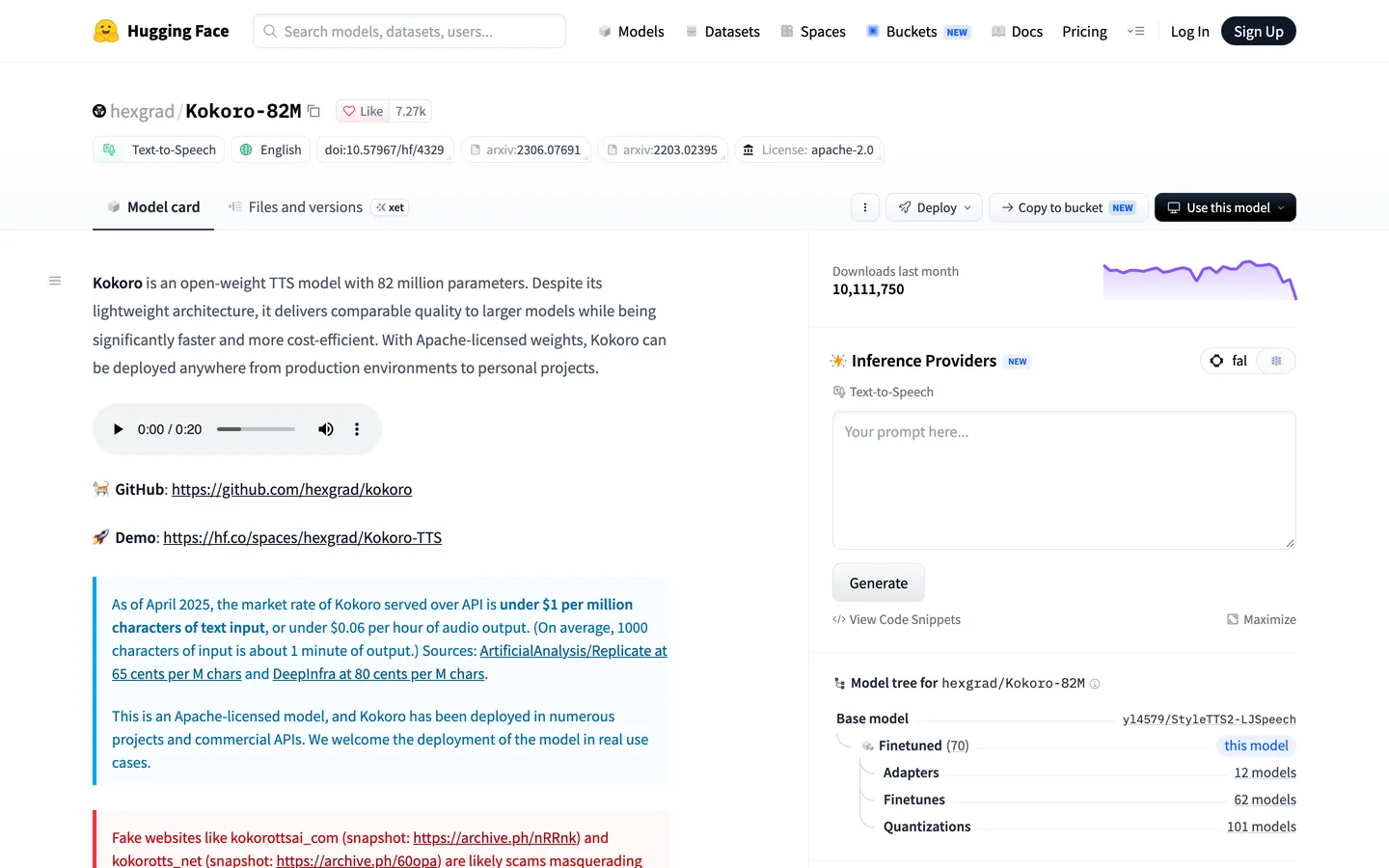
Short description
Kokoro is a free, open-source text-to-speech model with 82M parameters that runs on ordinary laptops and even CPUs, or costs under a dollar per million characters through hosted services. It is a free Apache-2.0 alternative to ElevenLabs' preset-voice TTS. It can't clone voices, so you pick from its stock voices, which suits bulk narration like turning ebooks or articles into audio rather than custom voice work. It competes on cost and speed, not on voices.
Features
54 preset voices in 8 languages: US and UK English, Spanish, French, Hindi, Italian, Brazilian Portuguese, Japanese and Mandarin in v1.0
Tiny footprint: 82M parameters let it run on CPU, Apple Silicon or modest GPUs
Voice mixing: The Kokoro-FastAPI server blends voices by weight, for example af_bella(2)+af_sky(1), to make new voices
Multi-speaker tags: Inline [voice:...] tags switch speakers within one request
Word-level timestamps: A captioned-speech endpoint returns word timings for subtitles and read-along
Pronunciation control: Phoneme endpoints, IPA pronunciation overrides, pause and speed tags, and experimental SSML markup
Voice tuner (experimental): Nudges a preset toward a 3-30 second reference clip. The README calls it a tuner, not a cloner.
Model version: v1.0 weights released January 27, 2025 and still widely used, based on the StyleTTS2 model
Pricing
How you pay: Free open weights to self-host, or cheap per-character hosted APIs
Free: $0 self-hosted under Apache-2.0, with commercial use allowed
DeepInfra: $0.99 per 1M characters, roughly 40-80x cheaper than ElevenLabs' $40-80
Replicate: About $0.0002 per run
Integrations
Platforms: Self-hosting through Python (pip install kokoro, which needs espeak-ng), Docker images for CPU, NVIDIA and experimental AMD GPUs, native Apple Silicon support, or hosted APIs on DeepInfra, Replicate and fal
OpenAI-compatible endpoint: Kokoro-FastAPI offers a /v1/audio/speech endpoint, so apps built for OpenAI's TTS can switch by changing the server address
Streaming audio: Output in mp3, wav, opus, flac, aac and pcm
Python libraries: The Kokoro Python library and the misaki library, which converts text into pronunciation sounds
Platforms
- Self-hosted (Python)
- Docker
- Apple Silicon
- Hosted APIs (DeepInfra, Replicate, fal)
What users love about Kokoro
Audiobook-scale speed: One user converted DRM-free ebooks into about 120 hours of audio in 1.5 hours on an AMD 7900 XTX, and another runs an ebook-to-audiobook site on an old GTX 980
Consistent over hours of narration: The voice doesn't drift the way some paid cloud TTS does, and sounds human without being overly dramatic
Blend voices instead of cloning: Mixing two presets on the fly gives a distinctive voice for most projects that don't need a specific real person
Runs almost anywhere: Rated the best cross-platform option across CPU, Apple Silicon, browser and Android. One builder used its OpenAI-compatible server to add phone voice chat to local agents at about 1.8 seconds of latency.
What users complain about Kokoro
No voice cloning: You are stuck with 54 stock voices, so a specific person's or character's voice needs another model
Questions sound like statements: Question and exclamation marks don't change delivery, and users want more expression
Missing languages: German, Russian, Turkish, Korean and others are frequent requests, with German speakers even offering to fund it, and native speakers find Mandarin misses neutral tones
Server crashes under load: The popular FastAPI server crashes on simultaneous or cancelled streaming requests, and memory climbs steadily over long sessions
Similar tools
Alternative AI options