Quorum
A web app that puts one question to three to five AI models (Claude, GPT, Grok, Gemini and DeepSeek), lets them answer alone and then cross-examine each other, and hands back one moderated verdict with the dissent on record. You get one free debate a day, and credits start at $7 for 20.
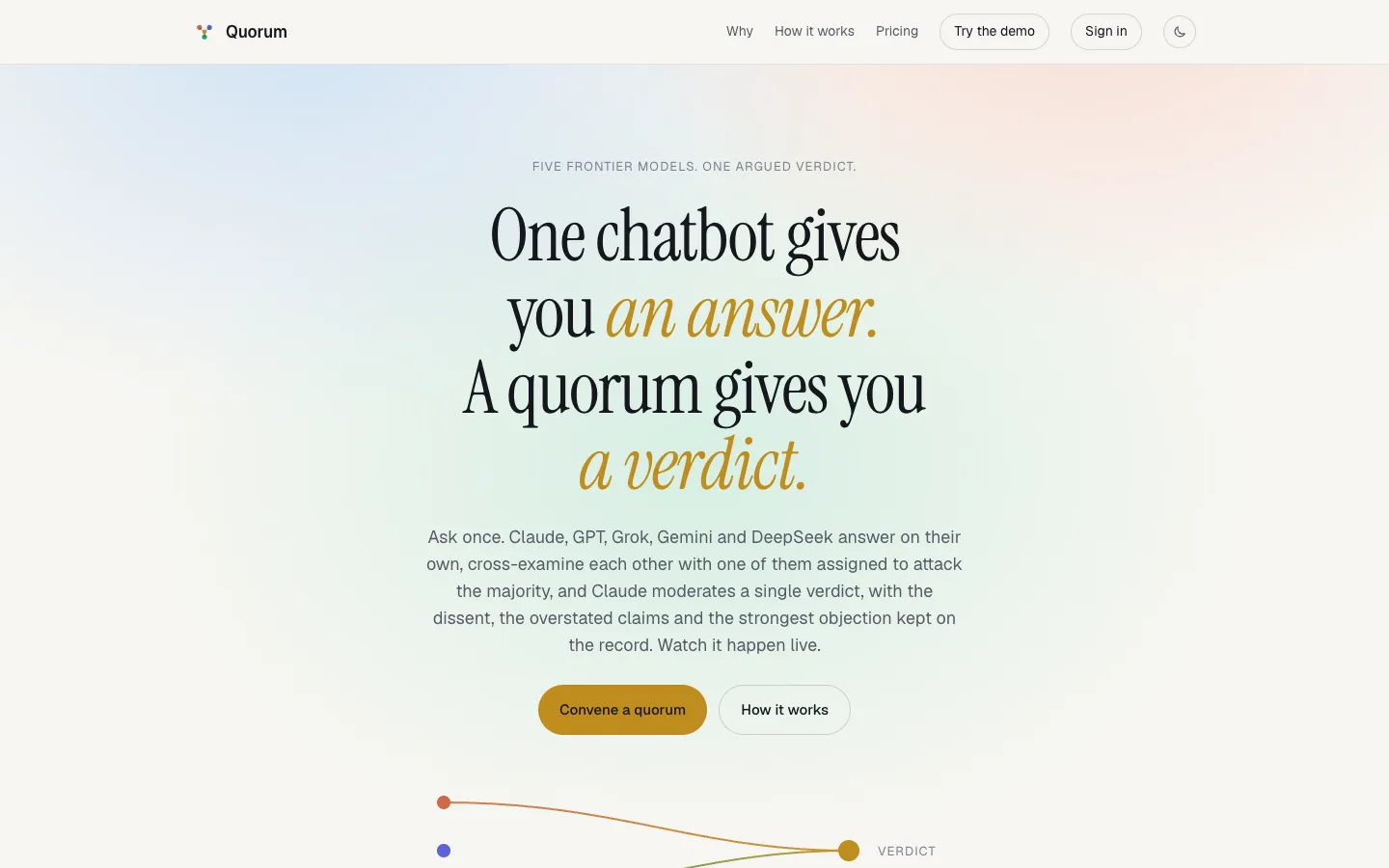
Short description
Quorum asks a panel of AI models your question. You pick three to five from Claude Fable 5.1, GPT 6.1 Sol, Grok 4.7, Gemini 4 Argon and DeepSeek V4 Pro. Each model writes its answer without seeing the others. The drafts are then swapped and the models cross-examine each other, with one of them told to argue against the majority. Claude moderates the result into a short verdict: two sentences, three reasons, where each model ended up, a check on any claim stated as an absolute, and the strongest objection, which is kept even when the whole panel agrees.
A second model called Jev, which writes no text of its own, scores how far each model's final position is from the verdict. That way the agreement score comes from a different model than the one that wrote the verdict. Answers stream in live and a debate takes about a minute. You can add your own view and say how much it should count, switch on a web brief with sources for recent topics, ask follow-ups, fork debates other people have shared, and share either the full transcript or only the verdict.
It's built for people weighing a decision who want to see where the models disagree. Quorum is run by Risk Averse Technology Company. Its terms are dated October 20, 2026, and it was listed on Uneed on November 10, 2026. The company doesn't say where it is based.
Features
Panel of up to five models: Choose from Claude Fable 5.1, GPT 6.1 Sol, Grok 4.7, Gemini 4 Argon and DeepSeek V4 Pro. Three to five sit on each debate, and you can bench any of them.
Independent first answers: Every model drafts its position before it sees anyone else's, so you get several separate lines of reasoning.
Cross-examination round: The drafts are exchanged and one model is assigned to argue against the majority. If a model adopts a point from another, it has to say so and explain why.
Moderated verdict: Claude writes a two-sentence verdict with three reasons, who ended where, a scope check on every claim stated as an absolute, and the dissent or the strongest objection.
Separate alignment score: Jev, a decision model, scores each model's final stance against the verdict. It also skips the cross-examination when the first answers already agree.
Live streaming: Answers appear as they're written, round by round. A full debate takes about a minute.
Web brief with sources: An optional search step runs before the first round for questions about things newer than the models' training, and it shows its sources.
Your own weighted view: Add your opinion and say how much weight it gets. The panel responds to it and the verdict says where it landed.
Follow-ups and forks: Continue your own debate, or take someone else's shared debate and run it with your question. Each one gets its own page.
Share links: Every debate has a page with a neutral headline and a preview card. You can share the whole transcript or the verdict alone, and the page doesn't show who asked.
Debate history: Signed-in users can find every debate they've run under "Your quorums".
Light and dark themes: Matches your system setting, or you can switch with a toggle.
Pricing
A credit pays for one debate with up to three models. A panel of four or five models costs two credits. Credits come in packs paid through Stripe and never expire.
Free without an account: One debate a day, no sign-in needed.
Free with an account: 3 credits when you sign in with email or Google.
20 credits: $7, about 35 cents each.
100 credits: $25, about 25 cents each.
Refunds: The credit comes back automatically if fewer than two models answer. Other purchases are final unless the law requires a refund or the company decides one is fair.
Subscriptions and Enterprise: Not published. Quorum sells credit packs only.
Integrations
AI providers: Questions go to Anthropic (Claude), OpenAI (GPT) and xAI (Grok). Google (Gemini) and DeepSeek are reached through Vercel AI Gateway when they're on the panel.
Google sign-in: Accounts are created through Clerk, a sign-in service, with an email address or a Google account.
Stripe: Takes payments for credit packs and sends receipts.
API: Not published.
Platforms
- Web
Frequently asked questions about Quorum
Can I ask multiple AI models the same question at once?▼
Yes. Quorum sends one question to three to five models at the same time, chosen from Claude Fable 5.1, GPT 6.1 Sol, Grok 4.7, Gemini 4 Argon and DeepSeek V4 Pro. Each answers on its own, they cross-examine each other, and Claude moderates one verdict. The debate streams live and takes about a minute.
Can I ask multiple AI at once for free?▼
Yes, with limits. Quorum gives you one free debate a day without an account and 3 free credits when you sign in. One credit covers a panel of up to three models, and a panel of four or five costs two. After that, credits cost $7 for 20 or $25 for 100.
How do you use multiple AI models together?▼
Quorum runs the models in rounds. They answer alone first, then read each other's drafts and cross-examine, with one model told to argue against the majority and any borrowed point named and justified. Claude writes the verdict, and a separate model called Jev scores how close each model's final stance is to it. You can add your own view with a weight, and the verdict says where it landed.
Is ChatGPT always right?▼
No chatbot is. Quorum's own terms say AI models can be confidently wrong, out of date, or wrong together, and that its verdict is not a fact check. What Quorum does is show where several models disagree, keep the dissent and the strongest objection on record, and flag claims stated as absolutes, so you know where to slow down.
Are my questions on Quorum private?▼
Your question goes to the AI providers on the panel, which handle it under their own API terms. Quorum stores debates so you can come back to them, and anyone with a debate's share link can read it, though they can't see who asked. Quorum says it doesn't sell data or show ads, and you can ask for deletion by email. It recommends leaving confidential information and other people's personal data out of your questions.
Similar tools
Alternative AI options