
Sourcegraph Cody
Enterprise AI coding assistant that uses code search to give AI agents context across large codebases.
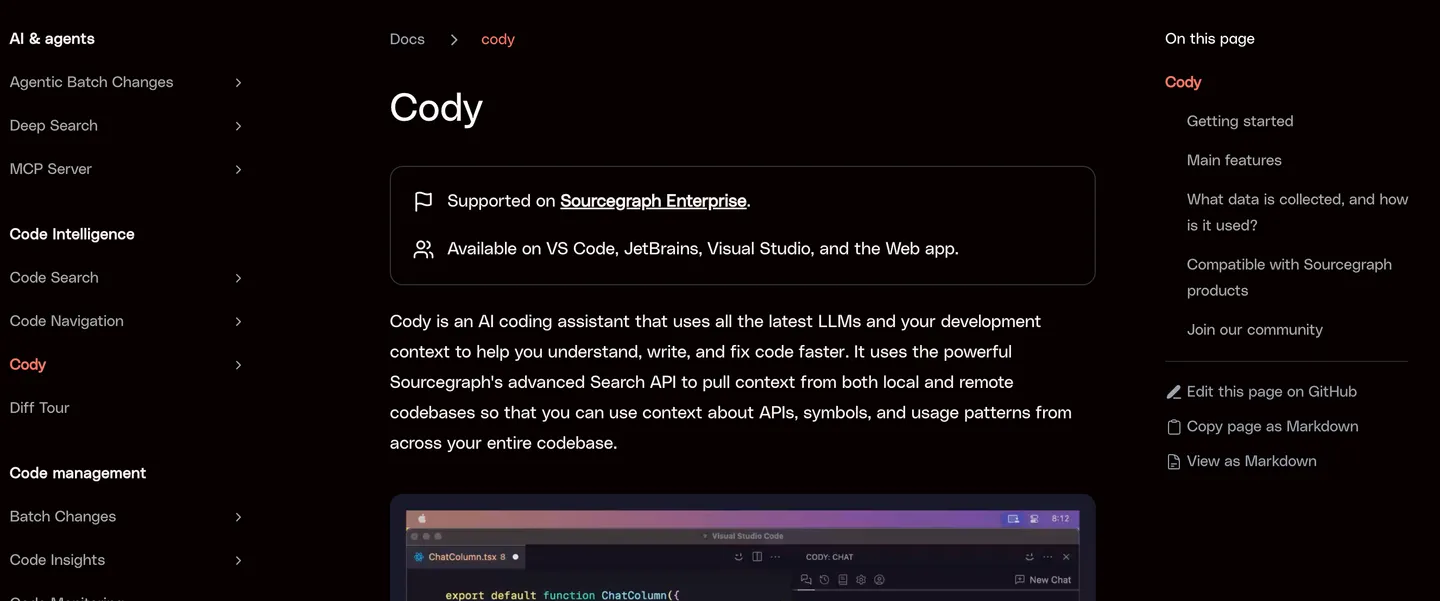
Short description
Cody is Sourcegraph’s enterprise AI coding assistant, built around its code-search and code-intelligence platform. It helps developers understand large, interconnected codebases by retrieving relevant code, symbols, and repository context. Since discontinuing its individual plans in July 2025, Sourcegraph has focused Cody on enterprise customers and expanded access to its code intelligence through integrations with external coding agents. Instead of replacing Cursor or Claude Code, Sourcegraph can provide these tools with deeper context from an organization’s repositories.
Features
Cross-repository context: Search across multiple repositories to find related code, dependencies, and usage patterns.
Code-aware AI answers: Combines keyword search, Sourcegraph Search, and code-graph relationships to retrieve relevant context for AI responses.
@-mention context: Explicitly reference repositories, files, symbols, directories, and URLs when asking questions.
Context filters: Include or exclude repositories to control which code is used in responses.
AI coding assistance: Cody supports chat, code completion, code edits, debugging, and reusable prompts within supported clients.
Deep Search: Investigate complex questions across a codebase using Sourcegraph’s code intelligence.
Agentic Batch Changes: Automate coordinated code changes across multiple repositories.
Sourcegraph MCP server: Give compatible coding agents access to Sourcegraph’s code-search capabilities through the Model Context Protocol.
Pricing
Enterprise: Custom pricing, starting at $16K
Former Free and Pro plans: Discontinued in July 2025.
Deployment options: Sourcegraph-managed cloud and self-hosted deployments, depending on the product and contract.
AI usage: Governed by enterprise licensing, configured model providers, and applicable usage limits.
Integrations
Coding agents: Claude Code, Cursor, Codex, Amp, OpenCode, and other supported MCP clients.
IDEs: VS Code, JetBrains IDEs, and Visual Studio, subject to supported configurations.
Code hosts: GitHub, GitLab, Bitbucket, Perforce, Gerrit, and Azure DevOps, depending on deployment and configuration.
APIs and protocols: MCP, GraphQL, and REST APIs.
Platforms
- Web App
- CLI
- Managed cloud and self-hosted Sourcegraph Enterprise environments
What users love about Sourcegraph Cody
Understanding large codebases: Developers value the ability to ask questions about how components, APIs, and services connect across repositories.
Relevant code search: Sourcegraph can find implementations and usage patterns that may be difficult to discover through manual browsing.
Works with existing tools: Teams can add Sourcegraph context to their preferred coding agents instead of forcing every developer to change editors.
Enterprise flexibility: Organizations appreciate support for multiple code hosts, access controls, and self-hosted deployment options.
Reusable team prompts: Shared prompts help engineering teams standardize common workflows such as debugging, refactoring, and documentation.
What users complain about Sourcegraph Cody
Individual plans were discontinued: Former Cody Free and Pro users lost access to the product, prompting some to move to alternatives such as Cursor, Copilot, and other coding agents.
Enterprise pricing: The shift to enterprise-only access puts Cody out of reach for many solo developers and small teams.
Uncertain product direction: Some users who liked Cody as an individual coding assistant were frustrated by the move toward enterprise customers and the transition to other Sourcegraph products.
Setup and integration complexity: Getting repository indexing, permissions, and agent integrations configured can require additional technical work.
Context is not perfect Out of the Box: Large codebases still require relevant search results and careful context selection; more indexed code does not guarantee better answers.