Chatterbox
MIT-licensed open-source text-to-speech family with Original, Turbo, Nano and Multilingual models, zero-shot cloning from a few seconds of audio, built-in watermarking and emotion control.
Short description
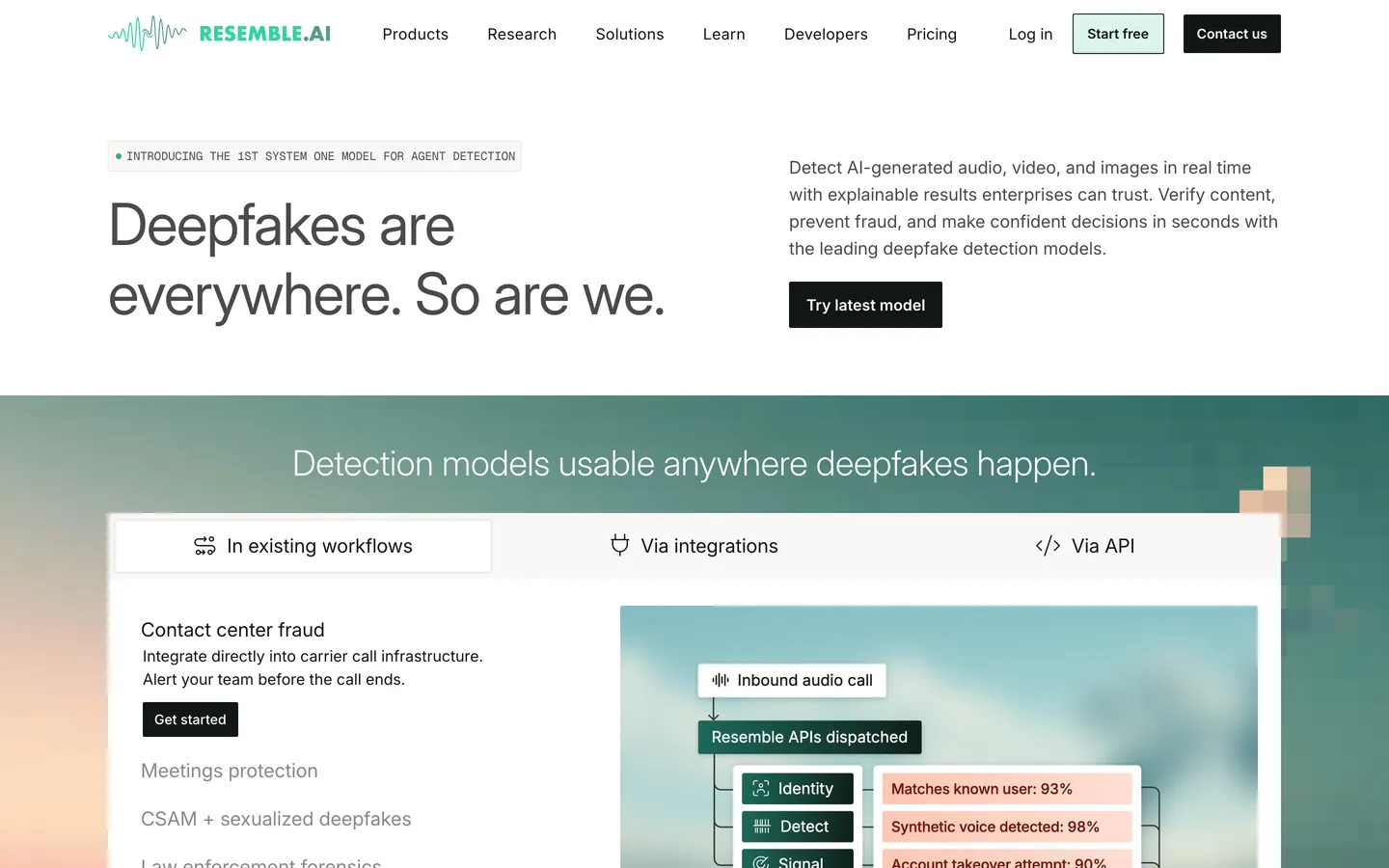
Chatterbox is a free, open-source text-to-speech model that you run on your own GPU or CPU, replacing ElevenLabs TTS and Instant Voice Cloning. It was built by Resemble AI, a voice company that moved its whole business to deepfake detection on August 13, 2026. Its voice models now sit under Voice AI Research, open and free to build on but no longer sold as paid products, and Resemble supports existing voice customers but takes no new ones. It is the open-source model people most often recommend for cloning a voice at home, though it needs some technical setup.
Features
Zero-shot voice cloning: Clones a voice from a 5-10 second reference clip, with no training step
Emotion exaggeration control: A single setting moves delivery from monotone to dramatic, in the original model
Sound tags: Inline [laugh], [cough] and [chuckle] produce non-speech sounds, in Turbo and Nano
Turbo (350M): English model for low-latency agents, with its audio decoder cut from 10 steps to 1 for speed
Nano (110M): English model for CPU and on-device use, which the vendor says runs about 3x real-time on 8 CPU cores
Multilingual V3 (500M): The newest release, covering 23+ languages, with six dedicated single-language versions including Chinese, Hindi, Spanish and Portuguese
PerTh watermark: Hides an inaudible watermark in every output and ships a script to detect it
Voice conversion: Example scripts restyle existing audio into a target voice
Pricing
How you pay: Free open-source software, where you pay only for your own GPU or CPU
Free: $0 under the MIT licence, with commercial use allowed and no character limits
Plans: None for TTS. Resemble's paid plans now cover only deepfake detection.
API: No hosted API for new customers. Self-hosting costs $0 vs ElevenLabs' $40-80 per 1M characters.
Caveat: Resemble left the voice business in August 2026, so there is no vendor support
Integrations
Platforms: Self-hosted only. Install with pip (chatterbox-tts, Python 3.11) on NVIDIA GPUs, CPU or Apple Silicon. Tested on Linux (Debian 11), and runs on Mac and Windows through Python.
Hardware: A community benchmark measured about 4.5GB of GPU memory and 8.8x real-time on an RTX 5090
Python API and Hugging Face weights: Use it from your own Python code, with model weights downloadable from Hugging Face
ComfyUI community nodes: A common way people run it inside the ComfyUI visual workflow tool
PerTh watermarker library: Separate open-source library at github.com/resemble-ai/Perth for adding and detecting watermarks
Code: github.com/resemble-ai/chatterbox, with model info at resemble.ai/learn/models/chatterbox
Platforms
- Self-hosted (Python)
- NVIDIA GPU
- CPU
- Apple Silicon
What users love about Chatterbox
Near-exact clones with natural rhythm: Local narration reproduces a reference voice almost exactly and gets the rhythm right without markup tags. A clean 10-second WAV is the recommended sample.
Runs on modest hardware: About 4.5GB of GPU memory at roughly 9x real-time on an RTX 5090, and one developer ships it fully offline on iPhone and Mac using about 3.2GB of RAM
Nano is fast and beats Kokoro on quality: A TTS fine-tuner who tested the major models found Nano better than Kokoro at similar speed for fast English
Record a rough read, convert it to the clone: Converting a spoken take into the cloned voice gives better pacing and inflection than typing text
What users complain about Chatterbox
Long generations fall apart: The original model cuts off around 40 seconds and Turbo wobbles and drops words after 25-30 seconds, so long narration needs splitting scripts. One YouTuber moved to Qwen3-TTS because of this.
One-word lines come out as gibberish: Inputs like Yes or Why? often fail, which audiobook-generator builders hit constantly on short dialogue
Random noise in Multilingual: German and French output gets random noise or invented words at the end of clips and artifacts where chunks are joined, making people wary of real-time production use
Install breaks on newer Python: Pinned NumPy and Python versions break installs on Python 3.13 and Colab, and some RTX 50-series owners found it wouldn't use their GPU
Accent carries across languages and weak Russian: Cloning from a sample in one language carries its accent into another, and Russian stress and pronunciation are poor
Similar tools
Alternative AI options