
Inworld TTS
Low-latency & low-cost real-time text-to-speech API for voice agents and consumer apps, with speech-to-text and an LLM router on the same API.
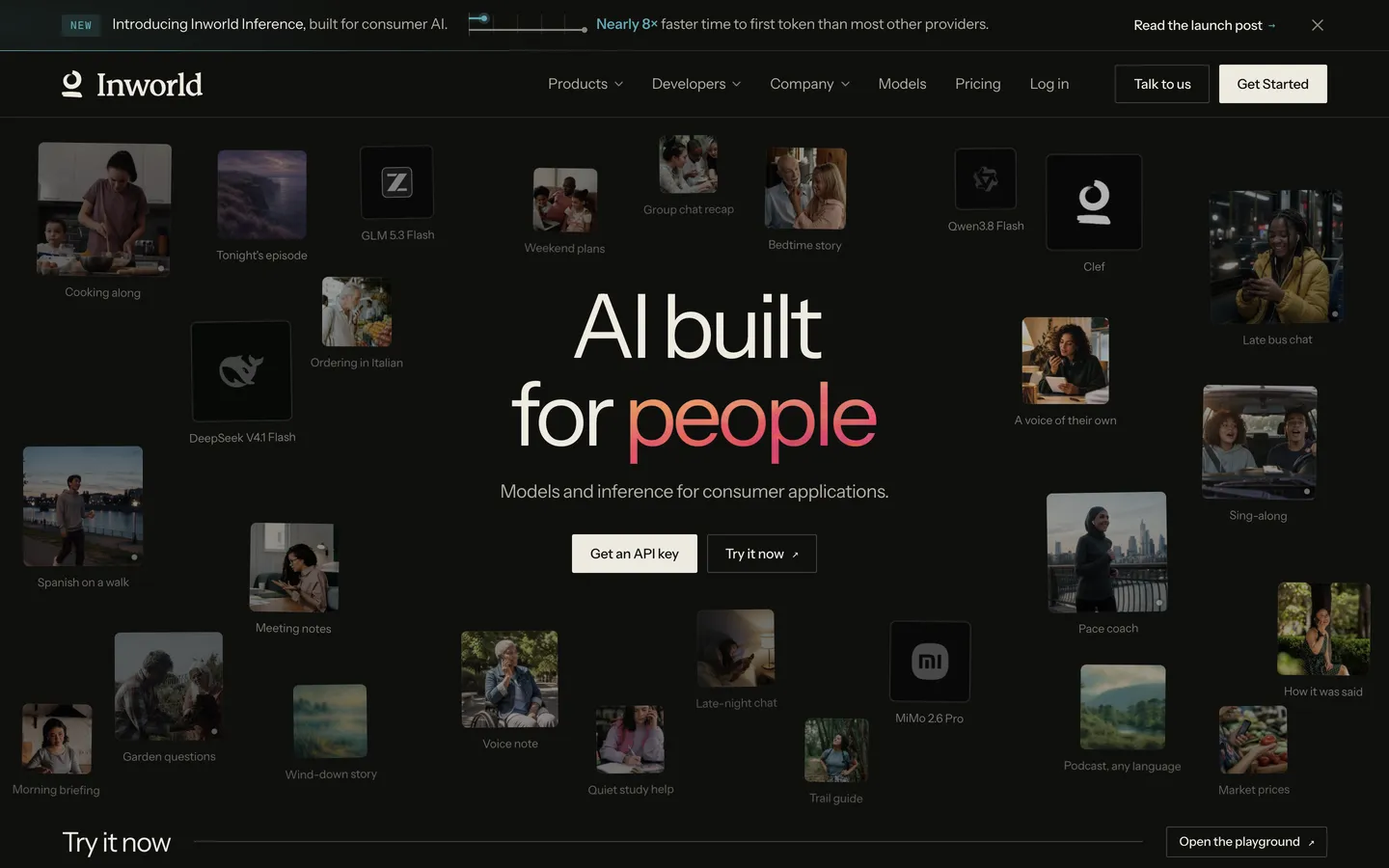
Short description
Inworld TTS is a text-to-speech API that developers use to give apps and voice agents a voice. Inworld started out making AI characters for video games and now sells voice infrastructure, describing itself as infrastructure for production voice AI. It is API-only, with no studio or editor. Its pitch is ElevenLabs-like voice quality for apps, agents and companions at a fraction of the per-character price.
Features
Realtime TTS-2 (inworld-tts-2): Flagship model with a vendor-stated ~100ms time to first audio for 90% of requests, plus control over delivery, pauses and pronunciation, and timestamps with phonemes and visemes (mouth shapes) for lip-syncing avatars
TTS-2 Flash (inworld-tts-2-flash): Cheapest and fastest model, with a vendor-stated ~20ms server-side response time, and as low as 50ms on the Coval benchmark per the vendor. It drops professional cloning and delivery control.
Instant voice cloning: Makes a voice from about 3-30 seconds of audio, on both models
Professional voice cloning (beta): Higher-quality clones on TTS-2 only, capped per plan
Voice design (preview): Creates a new voice from a text description
Speech Reasoning (beta): Writes delivery directions for each line automatically
Languages: The marketing page claims 500+ with dialects, while the docs list 200+. Flash covers fewer.
Retired models: TTS-1 and TTS-1-Max were shut down on 2026-06-15, with requests rerouted to newer models automatically. TTS-1.5 Max and Mini are deprecated.
Speech-to-text and LLM router: Available on the same API, so one vendor covers listening, thinking and speaking
Pricing
How you pay: Pay-per-character API, with optional monthly plans that pre-buy credit at a discount
Free: No free plan. On-Demand has no monthly fee and bills only per character.
Creator: $25/mo
Builder: $100/mo
Developer: $300/mo, with 10,000 custom voices
Growth: $1,500/mo
Enterprise: Custom
TTS-2 Flash: $7-15 per 1M characters depending on plan
TTS-2: $12.50-25 per 1M characters, vs ElevenLabs' $40-80
Rollover: Subscription credits roll over for 3 months
HIPAA: A Growth-plan add-on
Caveat: The lowest rates, as low as $5 per 1M, need an Enterprise sales deal
Integrations
Platforms: Web Playground, a cloud REST and streaming API. No on-device or open-weight model is offered.
OpenAI-compatible endpoint: api.inworld.ai/v1 works with the OpenAI SDK, so existing OpenAI code can switch over by changing the address
Voice agent frameworks: LiveKit Agents plugin for TTS and STT, and Pipecat listed as a partner, let you use Inworld in real-time agents
Developer tools: Command-line tool, MCP server and a coding-agent skill
ElevenLabs migration tool: Open-source tool on GitHub that runs locally to help move from ElevenLabs
Platforms
- Web Playground
- REST API
- Streaming API
What users love about Inworld TTS
ElevenLabs-level voices for a small fraction of the cost: Quality is on par with ElevenLabs for developers shipping voice at scale, which is why high-volume call builders get pointed to it
Natural fillers and emotion: Filler sounds and emotional delivery come out naturally, so back-and-forth conversation in consumer and companion apps sounds less scripted
Non-English voices sound native: Other languages sound authentic, not like an English voice reading a foreign script
One API for the whole voice stack: Speech-to-text, an LLM router and TTS come from one vendor instead of three separate services
What users complain about Inworld TTS
Real prices need a sales call: List prices aren't competitive, and the real volume rate needs a sales call, which is hard to justify before testing with actual users
Forced model migrations every few months: TTS-1 gave way to 1.5 and then TTS-2 within about a year, and TTS-1 was switched off in June 2026, so early adopters had to re-test and migrate
No studio for non-coders: With no studio or no-code editor, creators looking to replace ElevenLabs Studio can't use it without writing code
Hard-to-forecast bills: Per-character billing makes monthly costs hard to predict for high-traffic consumer apps
Similar tools
Alternative AI options